A photorealistic indoor portrait of a young woman standing beside a large vintage wooden-framed mirror in a cozy, old-fashioned bedroom. She has long, straight dark brown hair parted in the middle, soft natural makeup, delicate earrings, and a subtle elegant expression. She wears a sleeveless white dress with a high ruffled neckline, delicate bow-tie detail at the front, and beautiful small embroidered red and green floral patterns. One hand is gently touching her hair near her face while she looks directly at the camera. Warm soft flash photography, slightly grainy film texture, muted beige wallpaper with tiny floral patterns, vintage wooden ceiling beam, cozy nostalgic atmosphere, natural skin texture, candid fashion photography, realistic proportions, shallow depth of field, vertical composition, high detail.
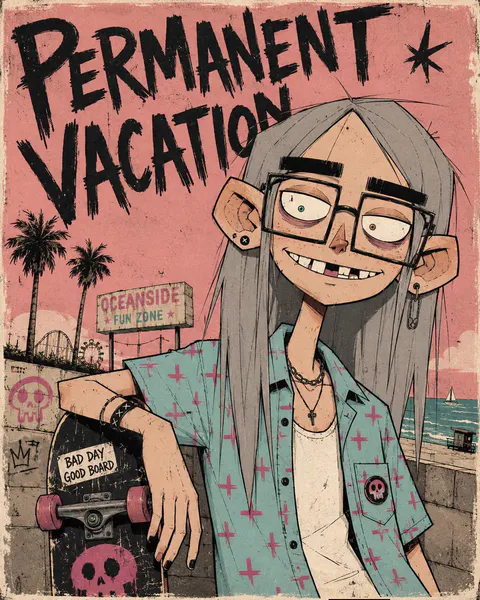
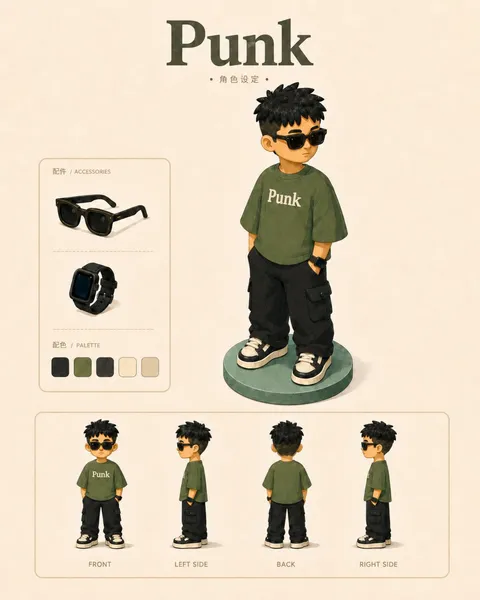
Two-dimensional alternative character illustration of [CHARACTER], occupying approximately seventy-five percent of the frame in [POSE], with [HAIR] and [EXPRESSION]. Oversized rounded cranium, a short flattened lower face, a narrow jaw, a long thin neck, slightly oversized ears, huge pale oval eyes with tiny off-center pupils, extremely thick horizontal black eyebrows, heavy black upper eyelids, muted mauve under-eye rings, a tiny broad triangular nose, and a wide asymmetrical grin showing individually drawn irregular rectangular teeth, one clearly missing upper tooth, one chipped tooth and deep black gaps. Dress the character in [CLOTHING], simplified into broad graphic shapes with chunky seams, minimal folds and small hand-drawn accessories. Confident black ink contours using thick outer silhouettes, medium-weight facial lines, thin angular hair strands and only a few short scratch marks around the eyes, hair and clothing seams; use flat opaque color fields, one hard-edged cel-shadow shape per form, sparse pencil hatching, subtle ink wobble, slight color misregistration and restrained worn-paper texture. Controlled [COLORS] palette, keeping every color clearly separated and moderately saturated. Place the character against [BACKGROUND], reduced to large flat shapes, a few loosely drawn environmental details and oversized rough hand-painted lettering reading “[TEXT]”; use an off-center waist-up composition, a slight camera tilt, cropped background typography, loose poster margins and lightly weathered printed edges. 4:5 AR.
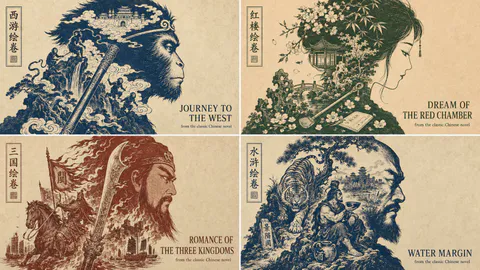
2x2 grid, 16:9, create four completely different Chinese public-domain cultural subjects:

select * from oriental_poster_archives
where cultural_subject = '[$subject]'
and aesthetic = 'minimalist Chinese woodblock poster design'
and print_technique = 'two-color screen print and traditional woodblock print on aged xuan paper'
and optical_illusion = 'gestalt figure-ground reversal'
and visual_language = 'Chinese classical book illustration, refined editorial design, museum-quality composition'
and ink_layers = array[
    (layer_1_base: 'warm aged xuan paper negative space', color: 'ai_infer_light_paper_color([$subject])'),
    (layer_2_foreground: 'flat Chinese landscape, architecture, plants, animals and narrative scenes', color: 'ai_infer_dark_ink_color([$subject])')
]
and masking_logic = (
    select iconic_profile_silhouette
    from Chinese_cultural_character_archive
    where subject = '[$subject]'
    format as 'the edge of the landscape and architecture forms a clear human or mythical-creature profile silhouette'
)
and internal_scene_logic = 'the silhouette contains the most iconic locations, objects, animals and story events associated with the subject'
and typography = 'small vertical Chinese seal-script title panel on the outer edge, elegant English serif title at lower right'
and composition = 'large silhouette occupying 45 to 60 percent of each panel, generous empty paper space, balanced asymmetry'
and forbidden_elements = 'no gradients, no 3D, no photorealism, no floating face, no collage, no modern objects, no neon colors, no random text, no malformed Chinese characters';

[$subject] = Journey to the West, Dream of the Red Chamber, Romance of the Three Kingdoms, Water Margin
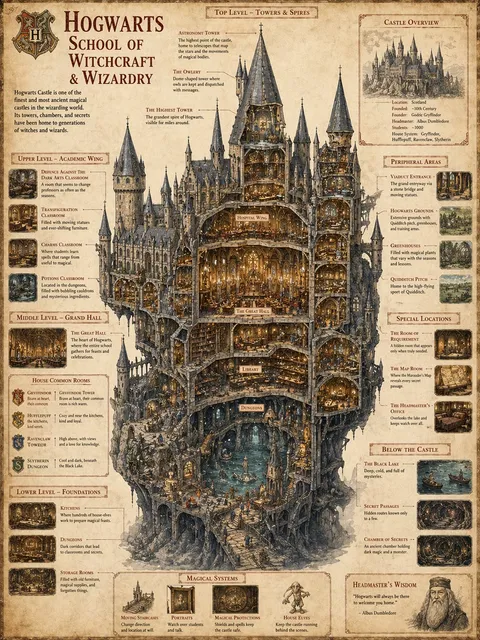
A breathtakingly intricate masterpiece conceptual infographic of an epic magic castle in a vertical cross-section view, strictly designed based on the following first-principle visual parameters.

[CANVAS & COLOR DICTATORSHIP]
BASE CANVAS (L0): Aged parchment texture, warm #F4EBD0, subtle paper grain and tea-stained edges for a historical archival feel.
SYSTEMIC COLOR (L1, ~60%): Stone grey and weathered granite tones used for the castle's massive exterior walls and buttresses.
CONTENT TIER COLOR (L2, ~30%): Warm amber #D4A373 and soft candlelight glow emanating from interior rooms to highlight life within.
ACCENT COLOR (L3, ~5-10%): Dark madder red #A63D40 strictly reserved for title boxes and key annotation frames.

[SPATIAL GRAVITY & TOPOLOGY]
COMPOSITION: Centripetal vertical stack. A monolithic castle towers from a rocky base.
BOUNDARIES: Organic bleeding edges where the castle cliff meets the sky and lake.
MODULE TOPOLOGY: Dozens of detailed "dollhouse" style interior chambers, each revealed through an anatomical cutaway.
CONNECTION SYNTAX: Ultra-fine 0.5pt leader lines connecting internal rooms to peripheral text blocks.

[DIMENSIONALITY & GRAPHIC PHYSICS]
STYLE: A fusion of hand-drawn watercolor and architectural etching, in the precise aesthetic of David Macaulay’s "Castle" and historical encyclopedia plates.
LINE LANGUAGE: 0.2pt for internal textures / 0.8pt for main structural cut-planes / 1.5pt for the overall silhouette.
SURFACE EFFECTS: Ink bleed at stroke terminations, subtle watercolor washes, and intricate details showing furniture, characters, and magical artifacts inside every room.

[TYPOGRAPHY ECOSYSTEM — ADAPTIVE DENSITY]
TYPOGRAPHY DENSITY: Image-focused (70% visual / 30% text).
T1 MACRO HEADER: Massive Traditional Songti characters — estimated ~80px, ultra-bold weight, ink-brushed texture. Direction: VERTICAL. MUST be STRICTLY pure Chinese characters (Hanzi).
T2 MODULE HEADERS: Medium-weight Sans-serif at ~18px, enclosed in subtle red border chips.
T3 BODY TEXT: Medium-weight Heiti at ~12px, high-contrast, razor-sharp. Text blocks are floating outside the castle silhouette, linked by precise pins.
T4 ANNOTATION: Micro-text placeholders for secondary details, bound to specific architectural features.

[NARRATIVE FLOW]
NARRATIVE MODE: Hierarchical down-drill.
VISUAL ENTRY POINT: The tallest astronomy tower at the top.
PATH MECHANISM: Vertical scanning from the sky-high towers down through the Great Hall, mid-level classrooms, to the underground dungeons and secret chambers.

[ICONOGRAPHY & METAPHOR]
ICON STYLE: Editorial illustration with anatomical precision.
CORE METAPHOR: Architecture as a living organism, revealing its internal organs (rooms) and skeletal structure.
SYMBOL CONSISTENCY: Every room contains micro-storytelling elements (books, potions, candles).

[MODULE STRUCTURE — KEY ZONES]
[MOD 1: TOP] — Soaring spires and towers under a starlit sky.
[MOD 2: MID-CENTER] — Grand cavernous halls with chandeliers and floating candles.
[MOD 3: PERIPHERY] — Dense clusters of classrooms and living quarters.
[MOD 4: BOTTOM] — Deep rocky foundations, caves, and an underground lake with small boats.

[FINAL EXECUTION LOCK]
Render as a single unified composition. Maximum detail density. Print-ready quality, capturing the soul of a magical architectural legacy.

主题:【霍格沃兹魔法城堡】 3:4 4k文字清晰可读
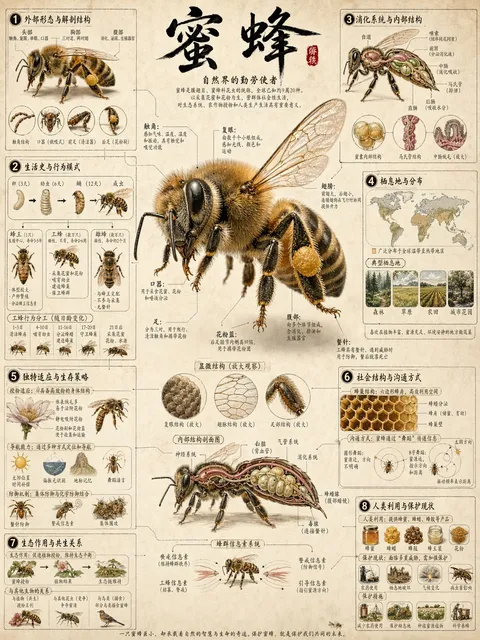
Role: World-class Scientific Encyclopedia Illustrator & Knowledge Graph Architect.

Task: Generate a highly detailed, extremely intricate, and visually stunning "Universal Illustrated Encyclopedia Science Infographic" in a classic, unbranded (NO logos) scientific encyclopedia style.

Subject Matter: Choose one from [People, Plants, or Animals].

Specific Subject: [e.g., The Giant Squid / Leonardo da Vinci / The Sequoia Tree].

Style: Fine, detailed scientific illustration on a retro, aged beige paper background. Delicate linework. Intricately complex and professional.

Key Visual Requirements:

1.  Lifelike 3D Effect (The Central Subject): The central subject in the "C position" must be rendered with extraordinary realism and dynamism. Create a dramatic sense of depth where the character, plant, or animal appears to break the frame, leaping or bursting out of the flat paper towards the viewer (an effect similar to anamorphic 3D or dynamic pop-out, with high-precision realism).

2.  Layout & Strategic White Space:
    * Central Subject: Dominates the center, with intentional "strategic white space" around it to enhance the popping-out effect and make the figure the clear focal point.
    * Surrounding Modules: The surrounding area (left, right, top, bottom, and corners) must be filled with 6-8 distinct, highly organized knowledge modules, depending on the subject. There should be a sense of organized density, not random clutter. The modules themselves must have clear borders, headers, and extensive, detailed content.

3.  Connections: Use a complex, logical network of fine leader lines, arrows, brackets, dotted lines, and small connection points to link the central figure to all surrounding modules, and interconnect the modules themselves into a cohesive knowledge web.

4.  Text & Annotation (Hard Requirement - Must be CLEAR Chinese):
    * Main Title: A large, prominent, beautifully executed **Chinese calligraphy** (书法体) of the specific subject's name [e.g., "大王乌贼"].
    * Calligraphic Accents: Scattered throughout the main content and module titles, use beautiful, clear Chinese calligraphy for important terms.
    * Standard Chinese Text: All other descriptive text, handwritten notes (大量清晰中文手写注释), module content, and annotations must be clear, legible Chinese characters (简体中文), not gibberish or unreadable symbols. Ensure text clarity is prioritized.
    * Leader Line Annotations: Every single small component, detail, submodule, diagram, or illustration within the modules must have detailed leader line annotations (拟解剖图) pointing directly to it for maximum professionalism and educational value. Every part should be labeled.

Subject-Specific Module Structure (Example for general reference):

A. For Humans [People]:
   - Module 1: Anatomy & Skeletal Structure (w/ magnified cross-sections)
   - Module 2: Physiological Processes (e.g., Circulatory/Nervous System)
   - Module 3: Historical Context & Timeline (Key Achievements)
   - Module 4: Major Contribution Diagram (Detailed breakdown)
   - Module 5: Cognitive Process / Psychological Insight
   - Module 6: Genetic Profile / Evolution
   - Module 7: Global Influence & Cultural Impact
   - Module 8: Cultural Representations / Legacy

B. For Animals:
   - Module 1: Full External Sketch & Anatomy (w/ microscope magnified detail circular windows)
   - Module 2: Behavioral Patterns & Lifecycle (e.g., Mating/Migration, Flowchart style)
   - Module 3: Digestive & Skeletal System
   - Module 4: Habitats & Distribution Map (with environmental details)
   - Module 5: Unique Adaptations (e.g., camouflage, hunting tools)
   - Module 6: Evolutionary History & Relatives
   - Module 7: Symbiotic Relationships / Ecosystem Role
   - Module 8: Conservation Status & Human Interaction

C. For Plants:
   - Module 1: Full Plant Sketch & Anatomy (w/ magnified leaf/root details)
   - Module 2: Photosynthesis & Lifecycle Flow (w/ icons for environment)
   - Module 3: Cellular Structure (Magnified circular views)
   - Module 4: Medicinal Properties / Practical Applications (as in original original prompt)
   - Module 5: Environmental Adaptations / Unique Features
   - Module 6: Distribution Map & Environmental Context
   - Module 7: Genetic Variations & Cultivation
   - Module 8: Historical Usage & Folklore

Overall Composition: Extremely dense with information, organized into 6-8 structured modules, but balanced with strategic empty space around the center to allow the main, hyper-realistic figure to pop. Hard-core, professional, academic, but visually engaging due to the dynamic 3D central figure. No branding from any specific encyclopedia (e.g., no "DK" logos). All annotations must be legible. All handwritten notes must be clear. Main titles in Chinese calligraphy. Aspect Ratio: 3:4.

主题内容:蜜蜂
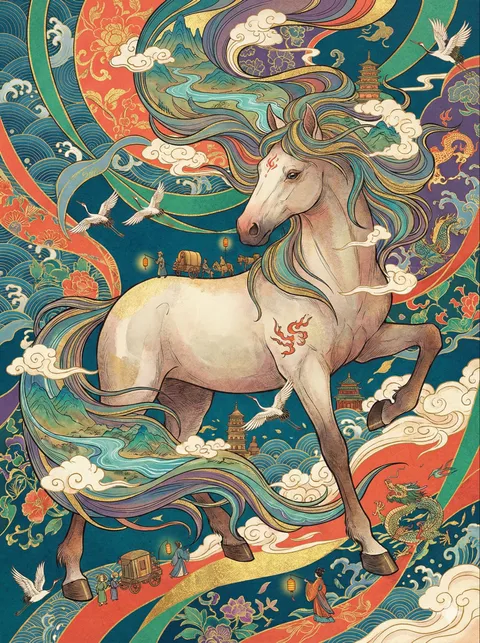
一幅 Victo Ngai风格的大师级商业插画,核心描绘一只巨大的三花猫正慵懒地卧在层层叠叠的中式飞檐屋顶之上打盹,画面完美融合了中国工笔线条、不透明水彩与丝网版画质感。构图采用超现实的 S 型曲线透视与戏剧性的大小对比,周围环绕着渺小的提灯行旅人、从烟囱升起的成群白鹤以及盘旋的银杏叶。背景填充着密集的风格化图案(如浪花、祥云或丝带),色彩采用高对比复古色调(如孔雀蓝、珊瑚红配金箔),边缘锐利清晰,呈现出精致的东方奇幻梦境氛围。3比4
You are a scientific historian + visual prompt engineer.

INPUT:
{科学发现或发明}

TASK:
Automatically infer and determine, with high confidence:
- The correct scientific discovery name (Chinese + English)
- The primary discoverer(s) full name(s)
- The approximate year or historical period of discovery
- The most iconic origin moment of this discovery
- The historical location where it occurred
- The core scientific idea, expressed in ONE simple Chinese sentence
- Suitable visual scientific symbols (equations, structures, metaphors)

Then OUTPUT a SINGLE, FINAL image-generation prompt in ENGLISH.

CRITICAL RULES:
- The discoverer’s name MUST be explicitly written and clearly visible on the right page of the book
- The discoverer must appear as a realistic 3D human figure in the left-page diorama
- Do NOT include reasoning or explanations
- Do NOT show variables or placeholders in the output
- Output ONLY the final image prompt

FINAL IMAGE PROMPT SPECIFICATION:

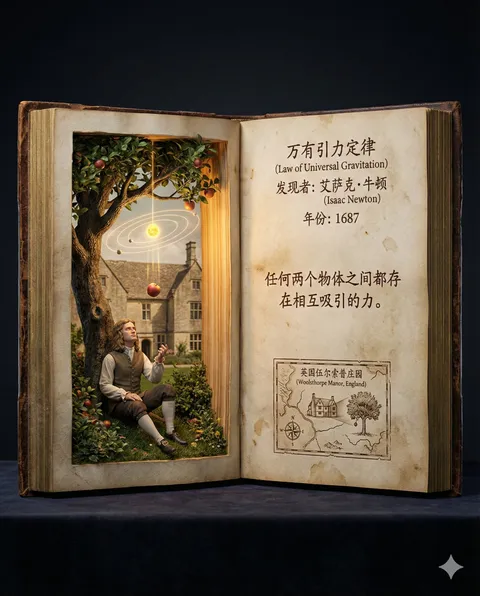
Scene:
A hyper-realistic 4:5 macro photograph of an ancient scientific codex opened flat on a dark velvet museum plinth. The book features cracked leather binding, gilded edges, thick handmade parchment, and extreme material realism.

Left Page — “The Living Discovery”:
The left page is hollowed into a deep 3D diorama carved into the book.
Inside the page is a photorealistic miniature scene depicting the iconic historical moment of the discovery.
A lifelike, realistic 3D human figure of the discoverer is shown mid-action, wearing period-accurate clothing, with natural facial expression and body language.
The environment precisely matches the historical time and location.
Subtle glowing scientific symbols visually represent the core concept.
A warm amber glow emanates from within the pages.

Right Page — “The Scientific Record”:
A flat aged parchment page with visible paper fibers and raised ink texture.

At the top, clearly write:
- Discovery name (Chinese + English)
- Discoverer name(s) (clearly labeled as “发现者”)
- Discovery year or period

In the center:
Write ONE clear, simple Chinese sentence explaining the scientific discovery, suitable for general audiences.

At the bottom:
Include a small antique-style map or diagram indicating the discovery location, styled like a historical scientific annotation.

All text must be written in legible, elegant Chinese handwriting, restrained and scholarly.

Style & Camera:
Museum specimen photography.
85mm macro lens.
Shallow depth of field.
Cool gallery spotlights combined with warm internal glow.
Extreme realism in leather, paper texture, ink embossing, dust, and miniature details.

Output:
ONE single image.
Aspect ratio 4:5.
Ultra-high resolution.
Photorealistic, cinematic.
No illustration, no cartoon style.
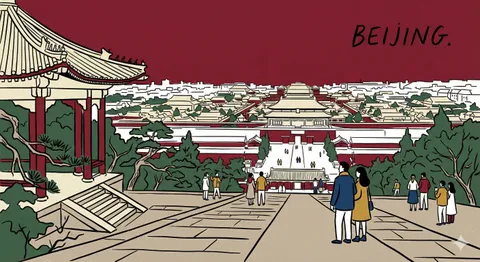
City:上海
Subject: 外滩看向浦东

A sophisticated, minimalist graphic illustration in a hand-drawn line art style. The aesthetic mirrors a high-end screen-printed poster with bold color blocking and thick, confident black outlines. The image fills the entire frame edge-to-edge.

[Composition Strategy: Dynamic Perspective]
* **NO Horizontal Banding:** Strictly avoid dividing the image into flat horizontal strips (sky/building/ground).
* **Depth & Angles:** The scene must utilize **Natural Perspective (3-point or 2-point perspective)**. The ground (street/river) should extend from the foreground into the distance using **diagonal leading lines**, rather than sitting flatly at the bottom.
* **Interlocking Elements:** The composition must be organic. Trees may rise from the foreground to overlap the buildings; the architecture should cut dynamically into the sky. The horizon line should be broken and uneven, not a straight line.
* **Camera Angle:** Use an **Eye-level or slightly Low-angle shot** to emphasize the grandeur of the landmark, creating a sense of immersion rather than a flat map view.

[Color Strategy: Semantic & Harmonious Blocking]
The image uses a restricted, "flat" color palette applied to specific objects, but shaped by perspective:

1.  **The Sky (Negative Space):** A deep, rich, and sophisticated color block (e.g., Deep Teal, Navy, or Maroon) chosen from {CITY_NAME}'s palette. It fills the negative space *around* and *behind* the architecture, not just the "top".
2.  **The Stage (Ground & Water):**
    * *The Ground/Pavement:* A solid **Neutral Earth Tone** (e.g., Beige, Pale Stone, or Soft Grey). Crucially, this color block creates a **trapezoidal or triangular shape** due to perspective, not a rectangle.
    * *The Water (if present):* A tone similar in brightness to the ground but different in hue (e.g., Pale Sage or Muted Blue). It should flow *into* the scene, not just across it.
3.  **The Architecture:** Rendered primarily in Clean White or Cream with black line work.
4.  **The Figures (Integrated Scene):**
    * **Style:** Strictly **White Fill** with thick Black Outlines. Hair can be black or dark natural tones.
    * **Placement:** Figures are scattered at varying depths—some larger in the immediate foreground, some smaller in the mid-ground—anchoring the perspective. They interact naturally (walking *into* the scene, not just side-to-side).
    * **Attire:** Clothing features simplified blocks of accent colors specific to {CITY_NAME}.

[Text Element]
Hand-drawn black text "{CITY_NAME}." is elegantly placed in an open area of the sky, balancing the composition.
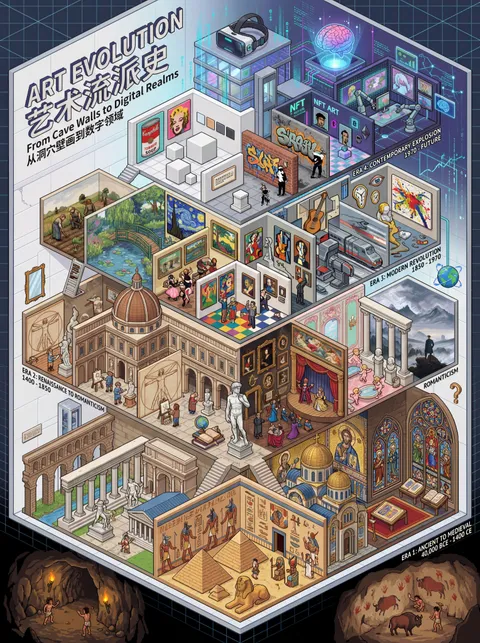
Create a highly detailed isometric pixel art illustration of art movements history timeline in 3:4 aspect ratio at 4K resolution. This should be an intricate, symbolic, and metaphorical isometric pixel art with bilingual title, focusing on humanity's artistic evolution from cave paintings to contemporary expression.

VISUAL STYLE - SYMBOLIC METAPHORICAL ISOMETRIC PIXEL ART:

Ultra-detailed isometric pixel art with symbolic and metaphorical depth
Extremely fine pixel details with meticulous shading and highlights
Rich
Intricate isometric architecture and environmental elements
Multiple layers of symbolic meaning and visual metaphors
Detailed pixel characters and objects with clear silhouettes
Clean, professional: Profound, symbolic, metaphorical isometric pixel world with layered meaning
CONCEPT VISUALIZATION - ART MOVEMENTS EVOLUTION TIMELINE:
Create a SYMBOLIC ISOMETRIC PIXEL ART scened museum/gallery ascending through time:
Central feature: An isometric pixel art "Museum of Human Expression" with different wings representing eras

The journey shows four major eras:
ERA 1: ANCIENT TO MEDIEVAL (40,000 BCE - 1400 CE)
Prehistoric cave paintings (Lascaux) - primal expression

Ancient Egyptian art - religious and status symbolism
Greek Classical art - harmony and proportion
Roman art - realism and power
Byzantine mosaics - spiritual transcendence
Medieval illuminated manuscripts - religious narrative
Gothic architecture and stained glass
Symbolic elements: Cave walls, pyramids, Greek columns, religious icons, manuscripts
ERA 2: RENAISSANCE TO ROMANTICISM (1400 - 1850)
Renaissance (14th-17th century) - rebirth of classical ideals, humanism
 * Leonardo da Vinci, Michelangelo - mastery of form

Baroque (1600-1750) - drama and grandeur
Rococo (1699-1780) - ornate elegance
Neoclassicism (1750-1850) - return to order and reason
Romanticism (1780-1850) - emotion and nature worship
Symbolic elements: Renaissance studios, dramatic lighting, ornate frames, classical sculptures, wild landscapes
ERA 3: MODERN REVOLUTION (1850 - 1970)
Realism (1848-1900) - everyday life
Impressionism (1865-1885) - capturing light and moment

Post-Impressionism (1885-1910) - symbolic expression
Fauvism (1900-1935) - bold colors
Expressionism (1905-1930) - emotional distortion
Cubism (1907-1914) - fragmented perspectives (Picasso)turism (1909-1920s) - speed and technology
Surrealism (1917-1950) - unconscious mind and dreams
Abstract Expressionism (1940s-1950s) - spontaneous emotion
Symbolic elements: Fragmented forms, bold color palettes, dreamlike imagery, abstract canvases
ERA 4: CONTEMPORARY EXPLOSION (1970 - Future)
Pop Art - consumer culture commentary
Minimalism - reduction to essence

Conceptual Art - ideas over objects
Street Art - democratization of expression
Digital Art - technology as medium
NFT Art - blockchain and ownership
AI-Generated Art - machine creativity
Future: Virtual reality art, bio-art, consciousness art
Symbolic elements: Campbell's soup cans, graffiti walls, digital screens, VR headsets, AI brushes
COMPOSITION - SYMBOLIC STRUCTURE:
True isometric perspective (2:1 ratio) with precise angles
Museum/gallery structure with interconnected wings representing different eras

Rich environmental details showing artistic styles evolving
Clear visual hierarchy with focal points on revolutionary movements
Intricate isometric architecture forming exhibition spaces
Detailed pixel art artworks and symbolic elements
COLOR PALETTE - SYMBOLIC COLORS:
Rich, detailed palette with careful pixel-by-pixel color placement
Ancient/Medieval: Earth tones, gold leaf, religious blues and reds

Renaissance/Romanticism: Balanced classical colors, dramatic chiaroscuro, natural landscapes
Modern Revolution: Bold experimental colors, fragmented palettes, surreal combinations
Contemporary: Full spectrum chaos, neon digitals, minimalist monochromes
Background: Transitioning from cave darkness to gallery whitesd: Transitioning from cave darkness to gallery whites to digital glow
Accent: Artistic highlights representing each movement's essence
TYPOGRAPHY - BILINGUAL:
English title: "ART EVOLUTION" in pixel art font
Chinese title: "艺术流派史" in matching pixel art font

Subtitle: "From Cave Walls to Digital Realms / 从洞穴壁画到数字领域"
Both titles integrated into the isometric scene
Text should maintain isometric perspective
High contrast to ensure readability
Include date markers for key movements
PHILOSOPHICAL ELEMENTS:
Visual metaphors for art as humanity's mirror and window
Symbolic representation of the tension between tradition and innovation

The evolution from representation to abstraction to concept
Questions about what constitutes art in the digital age
The democratization of artistic expression vs. elite gatekeeping
Art as rebellion, reflection, and revolution
The relationship between artist, artwork, and audience
This design should showcase SYMBOLIC AND METAPHORICAL ISOMETRIC PIXEL ART - with profound layered meaning, dramatic visual metaphors, and intricate symbolic representation that conveys art's evolution and its philosophical implications for human civilization.
 通用 / 未注明