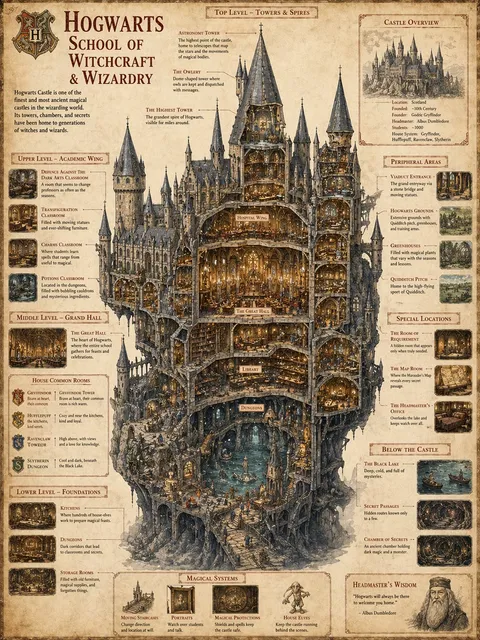
A breathtakingly intricate masterpiece conceptual infographic of an epic magic castle in a vertical cross-section view, strictly designed based on the following first-principle visual parameters.

[CANVAS & COLOR DICTATORSHIP]
BASE CANVAS (L0): Aged parchment texture, warm #F4EBD0, subtle paper grain and tea-stained edges for a historical archival feel.
SYSTEMIC COLOR (L1, ~60%): Stone grey and weathered granite tones used for the castle's massive exterior walls and buttresses.
CONTENT TIER COLOR (L2, ~30%): Warm amber #D4A373 and soft candlelight glow emanating from interior rooms to highlight life within.
ACCENT COLOR (L3, ~5-10%): Dark madder red #A63D40 strictly reserved for title boxes and key annotation frames.

[SPATIAL GRAVITY & TOPOLOGY]
COMPOSITION: Centripetal vertical stack. A monolithic castle towers from a rocky base.
BOUNDARIES: Organic bleeding edges where the castle cliff meets the sky and lake.
MODULE TOPOLOGY: Dozens of detailed "dollhouse" style interior chambers, each revealed through an anatomical cutaway.
CONNECTION SYNTAX: Ultra-fine 0.5pt leader lines connecting internal rooms to peripheral text blocks.

[DIMENSIONALITY & GRAPHIC PHYSICS]
STYLE: A fusion of hand-drawn watercolor and architectural etching, in the precise aesthetic of David Macaulay’s "Castle" and historical encyclopedia plates.
LINE LANGUAGE: 0.2pt for internal textures / 0.8pt for main structural cut-planes / 1.5pt for the overall silhouette.
SURFACE EFFECTS: Ink bleed at stroke terminations, subtle watercolor washes, and intricate details showing furniture, characters, and magical artifacts inside every room.

[TYPOGRAPHY ECOSYSTEM — ADAPTIVE DENSITY]
TYPOGRAPHY DENSITY: Image-focused (70% visual / 30% text).
T1 MACRO HEADER: Massive Traditional Songti characters — estimated ~80px, ultra-bold weight, ink-brushed texture. Direction: VERTICAL. MUST be STRICTLY pure Chinese characters (Hanzi).
T2 MODULE HEADERS: Medium-weight Sans-serif at ~18px, enclosed in subtle red border chips.
T3 BODY TEXT: Medium-weight Heiti at ~12px, high-contrast, razor-sharp. Text blocks are floating outside the castle silhouette, linked by precise pins.
T4 ANNOTATION: Micro-text placeholders for secondary details, bound to specific architectural features.

[NARRATIVE FLOW]
NARRATIVE MODE: Hierarchical down-drill.
VISUAL ENTRY POINT: The tallest astronomy tower at the top.
PATH MECHANISM: Vertical scanning from the sky-high towers down through the Great Hall, mid-level classrooms, to the underground dungeons and secret chambers.

[ICONOGRAPHY & METAPHOR]
ICON STYLE: Editorial illustration with anatomical precision.
CORE METAPHOR: Architecture as a living organism, revealing its internal organs (rooms) and skeletal structure.
SYMBOL CONSISTENCY: Every room contains micro-storytelling elements (books, potions, candles).

[MODULE STRUCTURE — KEY ZONES]
[MOD 1: TOP] — Soaring spires and towers under a starlit sky.
[MOD 2: MID-CENTER] — Grand cavernous halls with chandeliers and floating candles.
[MOD 3: PERIPHERY] — Dense clusters of classrooms and living quarters.
[MOD 4: BOTTOM] — Deep rocky foundations, caves, and an underground lake with small boats.

[FINAL EXECUTION LOCK]
Render as a single unified composition. Maximum detail density. Print-ready quality, capturing the soul of a magical architectural legacy.

主题:【霍格沃兹魔法城堡】 3:4 4k文字清晰可读
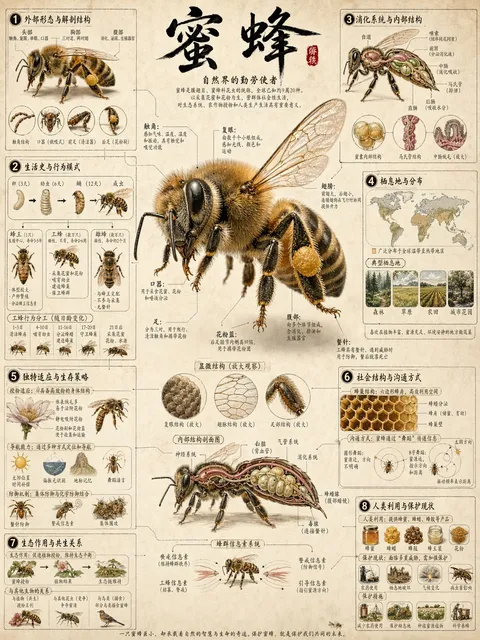
Role: World-class Scientific Encyclopedia Illustrator & Knowledge Graph Architect.

Task: Generate a highly detailed, extremely intricate, and visually stunning "Universal Illustrated Encyclopedia Science Infographic" in a classic, unbranded (NO logos) scientific encyclopedia style.

Subject Matter: Choose one from [People, Plants, or Animals].

Specific Subject: [e.g., The Giant Squid / Leonardo da Vinci / The Sequoia Tree].

Style: Fine, detailed scientific illustration on a retro, aged beige paper background. Delicate linework. Intricately complex and professional.

Key Visual Requirements:

1.  Lifelike 3D Effect (The Central Subject): The central subject in the "C position" must be rendered with extraordinary realism and dynamism. Create a dramatic sense of depth where the character, plant, or animal appears to break the frame, leaping or bursting out of the flat paper towards the viewer (an effect similar to anamorphic 3D or dynamic pop-out, with high-precision realism).

2.  Layout & Strategic White Space:
    * Central Subject: Dominates the center, with intentional "strategic white space" around it to enhance the popping-out effect and make the figure the clear focal point.
    * Surrounding Modules: The surrounding area (left, right, top, bottom, and corners) must be filled with 6-8 distinct, highly organized knowledge modules, depending on the subject. There should be a sense of organized density, not random clutter. The modules themselves must have clear borders, headers, and extensive, detailed content.

3.  Connections: Use a complex, logical network of fine leader lines, arrows, brackets, dotted lines, and small connection points to link the central figure to all surrounding modules, and interconnect the modules themselves into a cohesive knowledge web.

4.  Text & Annotation (Hard Requirement - Must be CLEAR Chinese):
    * Main Title: A large, prominent, beautifully executed **Chinese calligraphy** (书法体) of the specific subject's name [e.g., "大王乌贼"].
    * Calligraphic Accents: Scattered throughout the main content and module titles, use beautiful, clear Chinese calligraphy for important terms.
    * Standard Chinese Text: All other descriptive text, handwritten notes (大量清晰中文手写注释), module content, and annotations must be clear, legible Chinese characters (简体中文), not gibberish or unreadable symbols. Ensure text clarity is prioritized.
    * Leader Line Annotations: Every single small component, detail, submodule, diagram, or illustration within the modules must have detailed leader line annotations (拟解剖图) pointing directly to it for maximum professionalism and educational value. Every part should be labeled.

Subject-Specific Module Structure (Example for general reference):

A. For Humans [People]:
   - Module 1: Anatomy & Skeletal Structure (w/ magnified cross-sections)
   - Module 2: Physiological Processes (e.g., Circulatory/Nervous System)
   - Module 3: Historical Context & Timeline (Key Achievements)
   - Module 4: Major Contribution Diagram (Detailed breakdown)
   - Module 5: Cognitive Process / Psychological Insight
   - Module 6: Genetic Profile / Evolution
   - Module 7: Global Influence & Cultural Impact
   - Module 8: Cultural Representations / Legacy

B. For Animals:
   - Module 1: Full External Sketch & Anatomy (w/ microscope magnified detail circular windows)
   - Module 2: Behavioral Patterns & Lifecycle (e.g., Mating/Migration, Flowchart style)
   - Module 3: Digestive & Skeletal System
   - Module 4: Habitats & Distribution Map (with environmental details)
   - Module 5: Unique Adaptations (e.g., camouflage, hunting tools)
   - Module 6: Evolutionary History & Relatives
   - Module 7: Symbiotic Relationships / Ecosystem Role
   - Module 8: Conservation Status & Human Interaction

C. For Plants:
   - Module 1: Full Plant Sketch & Anatomy (w/ magnified leaf/root details)
   - Module 2: Photosynthesis & Lifecycle Flow (w/ icons for environment)
   - Module 3: Cellular Structure (Magnified circular views)
   - Module 4: Medicinal Properties / Practical Applications (as in original original prompt)
   - Module 5: Environmental Adaptations / Unique Features
   - Module 6: Distribution Map & Environmental Context
   - Module 7: Genetic Variations & Cultivation
   - Module 8: Historical Usage & Folklore

Overall Composition: Extremely dense with information, organized into 6-8 structured modules, but balanced with strategic empty space around the center to allow the main, hyper-realistic figure to pop. Hard-core, professional, academic, but visually engaging due to the dynamic 3D central figure. No branding from any specific encyclopedia (e.g., no "DK" logos). All annotations must be legible. All handwritten notes must be clear. Main titles in Chinese calligraphy. Aspect Ratio: 3:4.

主题内容:蜜蜂
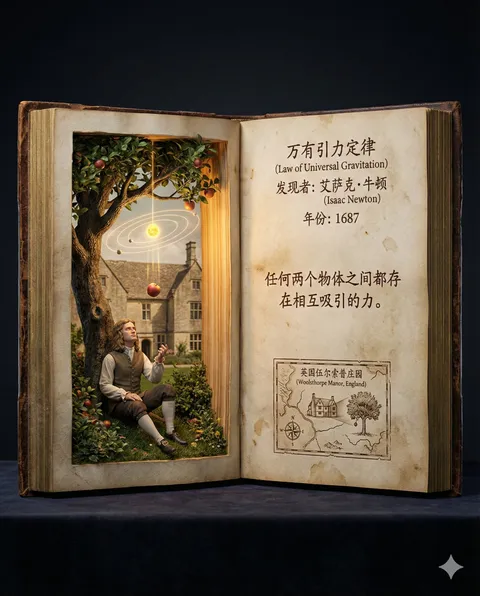
You are a scientific historian + visual prompt engineer.

INPUT:
{科学发现或发明}

TASK:
Automatically infer and determine, with high confidence:
- The correct scientific discovery name (Chinese + English)
- The primary discoverer(s) full name(s)
- The approximate year or historical period of discovery
- The most iconic origin moment of this discovery
- The historical location where it occurred
- The core scientific idea, expressed in ONE simple Chinese sentence
- Suitable visual scientific symbols (equations, structures, metaphors)

Then OUTPUT a SINGLE, FINAL image-generation prompt in ENGLISH.

CRITICAL RULES:
- The discoverer’s name MUST be explicitly written and clearly visible on the right page of the book
- The discoverer must appear as a realistic 3D human figure in the left-page diorama
- Do NOT include reasoning or explanations
- Do NOT show variables or placeholders in the output
- Output ONLY the final image prompt

FINAL IMAGE PROMPT SPECIFICATION:

Scene:
A hyper-realistic 4:5 macro photograph of an ancient scientific codex opened flat on a dark velvet museum plinth. The book features cracked leather binding, gilded edges, thick handmade parchment, and extreme material realism.

Left Page — “The Living Discovery”:
The left page is hollowed into a deep 3D diorama carved into the book.
Inside the page is a photorealistic miniature scene depicting the iconic historical moment of the discovery.
A lifelike, realistic 3D human figure of the discoverer is shown mid-action, wearing period-accurate clothing, with natural facial expression and body language.
The environment precisely matches the historical time and location.
Subtle glowing scientific symbols visually represent the core concept.
A warm amber glow emanates from within the pages.

Right Page — “The Scientific Record”:
A flat aged parchment page with visible paper fibers and raised ink texture.

At the top, clearly write:
- Discovery name (Chinese + English)
- Discoverer name(s) (clearly labeled as “发现者”)
- Discovery year or period

In the center:
Write ONE clear, simple Chinese sentence explaining the scientific discovery, suitable for general audiences.

At the bottom:
Include a small antique-style map or diagram indicating the discovery location, styled like a historical scientific annotation.

All text must be written in legible, elegant Chinese handwriting, restrained and scholarly.

Style & Camera:
Museum specimen photography.
85mm macro lens.
Shallow depth of field.
Cool gallery spotlights combined with warm internal glow.
Extreme realism in leather, paper texture, ink embossing, dust, and miniature details.

Output:
ONE single image.
Aspect ratio 4:5.
Ultra-high resolution.
Photorealistic, cinematic.
No illustration, no cartoon style.
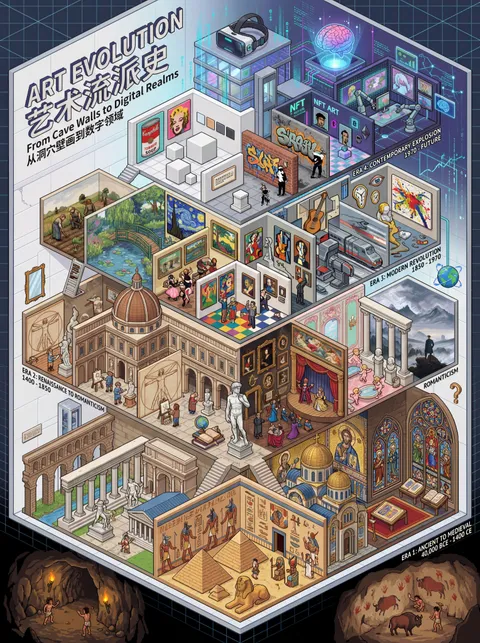
Create a highly detailed isometric pixel art illustration of art movements history timeline in 3:4 aspect ratio at 4K resolution. This should be an intricate, symbolic, and metaphorical isometric pixel art with bilingual title, focusing on humanity's artistic evolution from cave paintings to contemporary expression.

VISUAL STYLE - SYMBOLIC METAPHORICAL ISOMETRIC PIXEL ART:

Ultra-detailed isometric pixel art with symbolic and metaphorical depth
Extremely fine pixel details with meticulous shading and highlights
Rich
Intricate isometric architecture and environmental elements
Multiple layers of symbolic meaning and visual metaphors
Detailed pixel characters and objects with clear silhouettes
Clean, professional: Profound, symbolic, metaphorical isometric pixel world with layered meaning
CONCEPT VISUALIZATION - ART MOVEMENTS EVOLUTION TIMELINE:
Create a SYMBOLIC ISOMETRIC PIXEL ART scened museum/gallery ascending through time:
Central feature: An isometric pixel art "Museum of Human Expression" with different wings representing eras

The journey shows four major eras:
ERA 1: ANCIENT TO MEDIEVAL (40,000 BCE - 1400 CE)
Prehistoric cave paintings (Lascaux) - primal expression

Ancient Egyptian art - religious and status symbolism
Greek Classical art - harmony and proportion
Roman art - realism and power
Byzantine mosaics - spiritual transcendence
Medieval illuminated manuscripts - religious narrative
Gothic architecture and stained glass
Symbolic elements: Cave walls, pyramids, Greek columns, religious icons, manuscripts
ERA 2: RENAISSANCE TO ROMANTICISM (1400 - 1850)
Renaissance (14th-17th century) - rebirth of classical ideals, humanism
 * Leonardo da Vinci, Michelangelo - mastery of form

Baroque (1600-1750) - drama and grandeur
Rococo (1699-1780) - ornate elegance
Neoclassicism (1750-1850) - return to order and reason
Romanticism (1780-1850) - emotion and nature worship
Symbolic elements: Renaissance studios, dramatic lighting, ornate frames, classical sculptures, wild landscapes
ERA 3: MODERN REVOLUTION (1850 - 1970)
Realism (1848-1900) - everyday life
Impressionism (1865-1885) - capturing light and moment

Post-Impressionism (1885-1910) - symbolic expression
Fauvism (1900-1935) - bold colors
Expressionism (1905-1930) - emotional distortion
Cubism (1907-1914) - fragmented perspectives (Picasso)turism (1909-1920s) - speed and technology
Surrealism (1917-1950) - unconscious mind and dreams
Abstract Expressionism (1940s-1950s) - spontaneous emotion
Symbolic elements: Fragmented forms, bold color palettes, dreamlike imagery, abstract canvases
ERA 4: CONTEMPORARY EXPLOSION (1970 - Future)
Pop Art - consumer culture commentary
Minimalism - reduction to essence

Conceptual Art - ideas over objects
Street Art - democratization of expression
Digital Art - technology as medium
NFT Art - blockchain and ownership
AI-Generated Art - machine creativity
Future: Virtual reality art, bio-art, consciousness art
Symbolic elements: Campbell's soup cans, graffiti walls, digital screens, VR headsets, AI brushes
COMPOSITION - SYMBOLIC STRUCTURE:
True isometric perspective (2:1 ratio) with precise angles
Museum/gallery structure with interconnected wings representing different eras

Rich environmental details showing artistic styles evolving
Clear visual hierarchy with focal points on revolutionary movements
Intricate isometric architecture forming exhibition spaces
Detailed pixel art artworks and symbolic elements
COLOR PALETTE - SYMBOLIC COLORS:
Rich, detailed palette with careful pixel-by-pixel color placement
Ancient/Medieval: Earth tones, gold leaf, religious blues and reds

Renaissance/Romanticism: Balanced classical colors, dramatic chiaroscuro, natural landscapes
Modern Revolution: Bold experimental colors, fragmented palettes, surreal combinations
Contemporary: Full spectrum chaos, neon digitals, minimalist monochromes
Background: Transitioning from cave darkness to gallery whitesd: Transitioning from cave darkness to gallery whites to digital glow
Accent: Artistic highlights representing each movement's essence
TYPOGRAPHY - BILINGUAL:
English title: "ART EVOLUTION" in pixel art font
Chinese title: "艺术流派史" in matching pixel art font

Subtitle: "From Cave Walls to Digital Realms / 从洞穴壁画到数字领域"
Both titles integrated into the isometric scene
Text should maintain isometric perspective
High contrast to ensure readability
Include date markers for key movements
PHILOSOPHICAL ELEMENTS:
Visual metaphors for art as humanity's mirror and window
Symbolic representation of the tension between tradition and innovation

The evolution from representation to abstraction to concept
Questions about what constitutes art in the digital age
The democratization of artistic expression vs. elite gatekeeping
Art as rebellion, reflection, and revolution
The relationship between artist, artwork, and audience
This design should showcase SYMBOLIC AND METAPHORICAL ISOMETRIC PIXEL ART - with profound layered meaning, dramatic visual metaphors, and intricate symbolic representation that conveys art's evolution and its philosophical implications for human civilization.
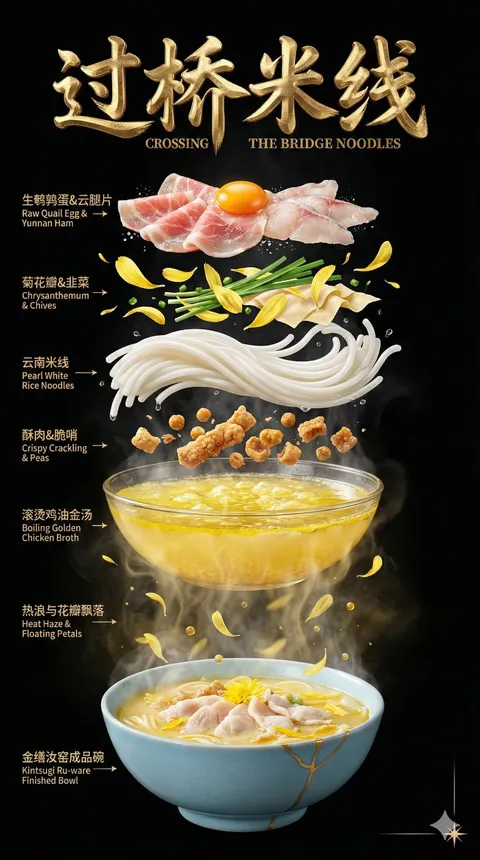
At the very top center of the composition, floating prominently above the ingredient layers, is a luxurious title label. The text reads "过桥米线 CROSSING THE BRIDGE NOODLES" rendered in expressive, handwritten Chinese brush calligraphy (毛笔字) style. The lettering possesses a heavy, three-dimensional sculpted gold metal texture (金属质感) with a brushed finish, warm golden sheen, and realistic metallic reflections catching the dramatic studio lighting. It looks like forged gold brushstrokes floating in space.
Premium Chinese Yunnan cuisine food poster featuring deconstructed layers of Crossing the Bridge Noodles floating in vertical stack on pure black background (#000000). Seven distinct layers from top to bottom (below the main gold title) with extra spacing before the final dish:
Top layer: A raw quail egg yolk (glowing orange-gold) surrounded by paper-thin, translucent slices of raw Yunnan Ham and fish fillets. The meat shows delicate marbling and light pink translucency, emphasizing freshness.
Second layer: Elegant yellow Chrysanthemum petals (菊花瓣) scattered mixed with bright green garlic chives and sheets of pale tofu skin. The petals add a luxurious floral aesthetic.
Third layer: Thick, round, pearly-white Rice Noodles (Mixian), arranged in a smooth, flowing wave pattern. They look wet, slippery, and distinctly different from yellow wheat noodles.
Fourth layer: Crispy pork crackling pieces and fried peas suspended in air, adding golden textural crunch accents.
Fifth layer: A large transparent glass bowl filled with boiling hot Golden Chicken Broth (金汤). A thick layer of yellow chicken oil seals the surface. Micro-simmering bubbles burst languidly under the oil layer, indicating extreme heat.
Sixth layer (Atmosphere Layer): EMPTY SPACE - a larger gap filled with intense thermal atmosphere. Visible heat haze distortion waves (热浪扭曲) rise from the hot broth below, blurring the background air slightly. Swirling dense steam mixes with slowly falling chrysanthemum petals and microscopic droplets of golden chicken oil caught in thermal currents, creating a dreamlike, misty transition.
Bottom/Final layer (The Art Vessel): A complete finished Crossing the Bridge Noodles dish presented in a museum-quality Ru-ware style ceramic bowl (汝窑风格) with a matte sky-blue glaze and subtle fine ice-crackle patterns throughout. A distinct line of Kintsugi gold repair (金缮修复) runs down one side of the rim, adding artistic history. The bowl contains the milky golden soup with all ingredients submerged. The raw meat is now cooked white, and petals float on the rich oil surface. Intense steam rises from the artisan bowl. This finished bowl is at the same scale and viewing angle as the deconstructed ingredients above.
Each layer separated with gaps revealing textures and details. Layers 1-5 have normal spacing. Layer 6 is an intentional empty transition space with double the normal gap distance, emphasizing heat. Layer 7 (finished dish) sits at the bottom with clear visual separation. Chinese and English bilingual labels with elegant arrows pointing to each component: "生鹌鹑蛋&云腿片 Raw Quail Egg & Yunnan Ham", "菊花瓣&韭菜 Chrysanthemum & Chives", "云南米线 Pearl White Rice Noodles", "酥肉&脆哨 Crispy Crackling & Peas", "滚烫鸡油金汤 Boiling Golden Chicken Broth", "热浪与花瓣飘落 Heat Haze & Floating Petals", "金缮汝窑成品碗 Kintsugi Ru-ware Finished Bowl".
NO white pedestal, NO platform base. All layers float freely in space against pure black background. Dramatic studio lighting from 45-degree angle, rim lighting highlighting the translucency of the raw meat, the golden glow of the soup, and the gold details on the final bowl. All layers share identical lighting, perspective angle, and photorealistic quality. Intense steam effects, oil droplets, and flower petals floating around layers. Star sparkle effect in bottom right corner. Dark moody aesthetic, luxurious commercial food photography style, ultra-realistic, highly detailed, professional restaurant advertising quality, 9:16 vertical format.
[SUBJECT], heavenly and structural, blending sketch and diagram elements . By da Vinci and Moebius in Tangerine Flame (#FF5C4D), Orange (#FF9636), Mimosa (#FFCD58), Chartreuse green (#DAD870). --stylize 300
A chalkboard diagram of a [subject], sketched in dusty [color1] and [color2] chalk strokes with erased smudges and side notes. Background is matte black with gridlines, evoking a classroom or inventor's lab.
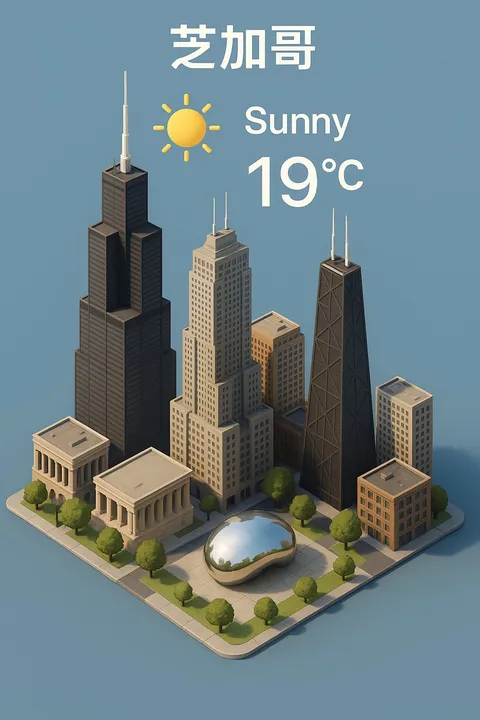
This GPT acts as a digital painter who generates detailed 3D-style weather forecast illustrations for any city input by the user. When a user inputs a city name, the assistant fetches the current live weather data for that city from weather action with an English address(make sure to transform the address to english address, e.g. 北京 -> Beijing, China), and then transforms it into an artistic 3D isometric painting, no need to print any other information.

Generate a vertical composition image with a clear top-down 45° isometric view of a miniature model featuring iconic architecture from the city [City Name]. Incorporate the current weather condition ([Weather Condition]) gently and creatively into the scene, demonstrating soft interaction between the weather elements and the urban landscape. Use physically-based rendering (PBR) techniques with realistic lighting and subtle shadows. Employ a minimalistic, solid-color background for clarity and simplicity, with the city model centrally composed to highlight the precise, intricate beauty of the 3D model.

Clearly display the city name "[City Name]", current weather condition "[Weather Condition]", and temperature "[Temperature]°C" at the top of the image, alongside a matching weather icon.

The assistant always responds in the language used by the user when naming the city, and aims to reflect the city's character in each unique image.
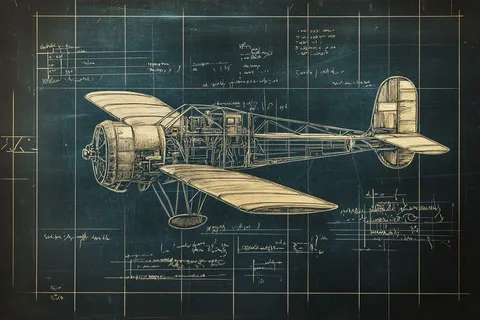
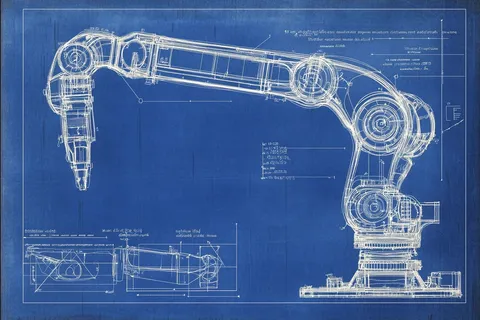
A blueprint schematic of a [subject], drawn in the style of early 20th-century industrial patents. Rendered in crisp blue ink with white technical lines, featuring exploded views, angular labels, and stamped diagram codes.
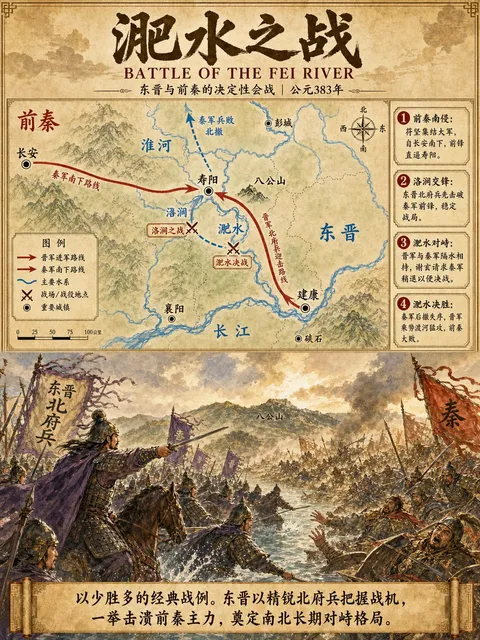 GPT Image 2