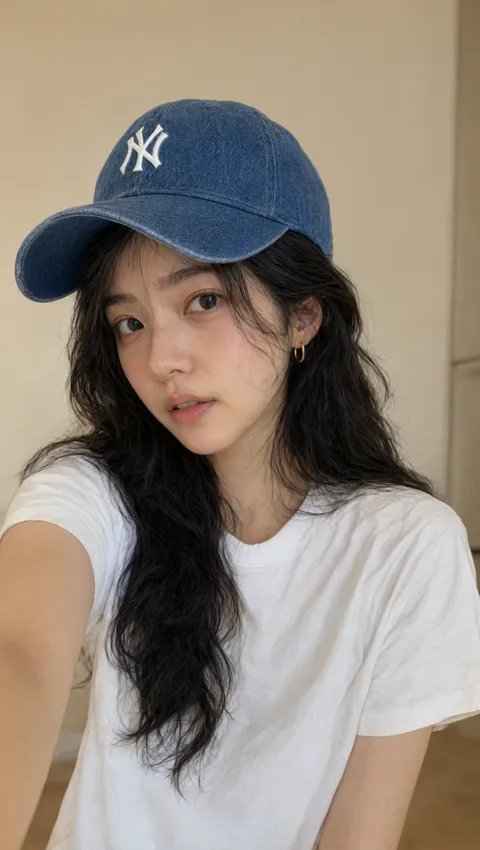
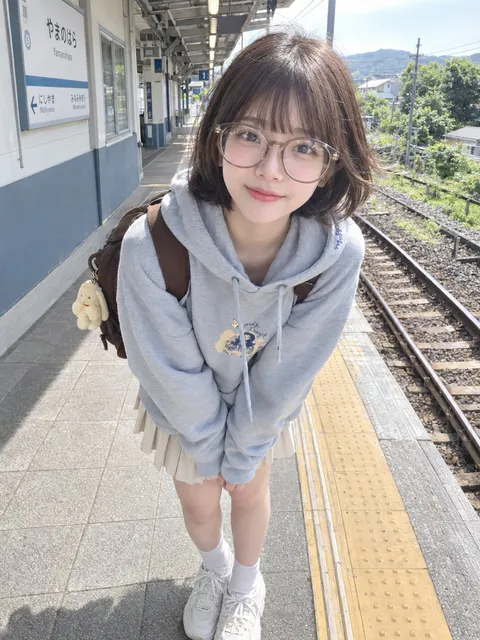
A close-up selfie portrait of a young East Asian woman in her early 20s with fair, smooth porcelain skin and soft natural features. She has long, wavy, slightly messy black hair cascading over her shoulders and framing her face, with some strands falling loosely across her forehead and cheeks. She is wearing a classic blue denim baseball cap with a white embroidered “NY” logo on the front, the cap slightly tilted, and a plain white short-sleeve t-shirt. A small gold hoop earring is visible in her left ear.

She looks directly at the camera with large, dark brown eyes, soft natural makeup, glossy pink lips slightly parted, and a calm, gentle, slightly shy expression. The shot is taken from a high selfie angle with her right arm extended toward the camera (hand out of frame), creating a natural first-person perspective. Soft, warm indoor lighting illuminates her face evenly with gentle shadows, giving a cozy, intimate atmosphere. The background is a plain light beige or off-white wall, slightly out of focus.

Photorealistic style, high detail on skin texture, hair strands, fabric of the denim cap and cotton t-shirt, natural color grading with warm tones, shallow depth of field, vertical portrait orientation, CapCut AI aesthetic.
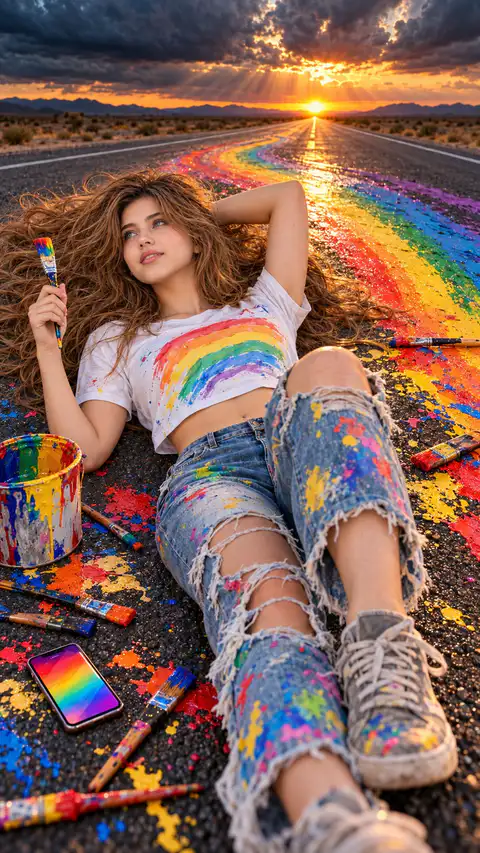
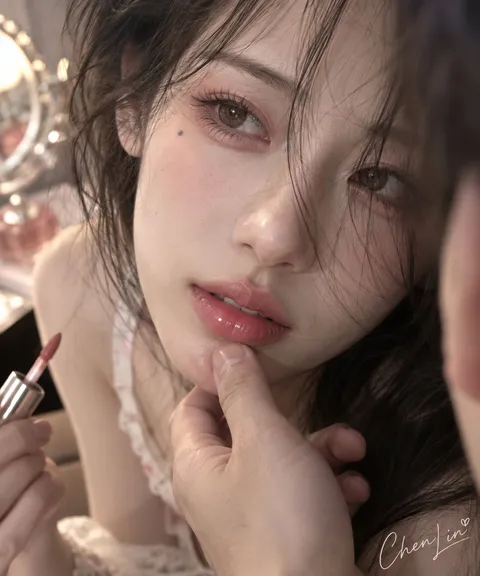
Hyper-realistic IMAX-level Netflix-style cinematic surrealist rainbow-paint photography, 9:16 vertical. Use the uploaded image as the primary visual reference and preserve the exact facial identity, proportions, and defining features. Create a woman wearing a white cropped T-shirt printed with a pastel rainbow, distressed blue jeans with large frayed knee openings and colourful paint splatters, and grey lace-up sneakers marked with traces of paint. She lies diagonally across the asphalt road, her upper body resting comfortably on the ground and her long hair spread widely around her head. One knee is raised prominently toward the camera, making the sneaker appear large in the foreground, while her other leg extends diagonally toward the lower edge. Her left arm bends above her head with the hand resting behind her hair, while her right hand holds a small paintbrush upright beside her face. Her face turns slightly upward toward the left, her blue eyes gazing dreamily toward the sunset, eyebrows relaxed and lips forming a gentle, playful smile. Her long, voluminous chestnut-brown hair fans out across the road, with loose waves and individual strands scattered naturally over the painted surface. Fair luminous porcelain skin with a bright ivory to light beige tone and a neutral-cool undertone, natural skin texture and soft rosy highlights. A long, straight desert highway stretches toward the distant horizon, where the setting sun sits directly above the vanishing point beneath dramatic dark storm clouds. A thick, glossy rainbow-coloured paint trail curves along the road behind and around her, transitioning through red, orange, yellow, green, blue, and violet. Paintbrushes of different sizes, colourful splashes, a paint-covered bucket and a smartphone with a vivid rainbow screen are scattered across the foreground. Warm golden sunbeams break through the clouds, illuminating the paint and creating a striking contrast against the dark asphalt and stormy sky. Apply rich cinematic colour grading with fiery amber highlights, deep charcoal shadows, vivid saturated rainbow pigments, subtle teal-blue atmospheric tones and controlled contrast. Emphasize the wet, glossy paint, realistic road texture, dimensional clouds, glowing sunset rays and crisp foreground details, with a polished surreal editorial finish.
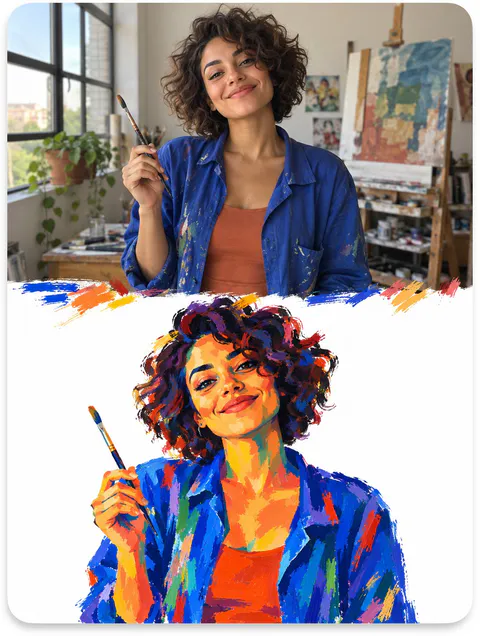
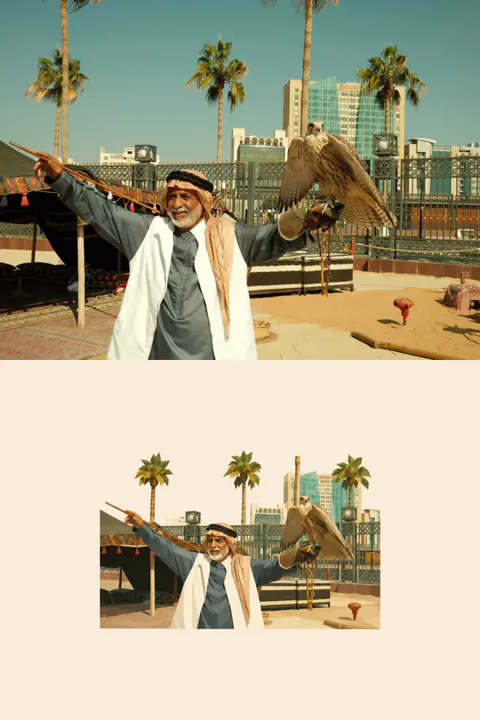
Transform the uploaded real photo into a minimalist low-poly editorial illustration.

Use the original photo as the visual source.

Faithfully preserve:
- the main subject
- pose and gesture
- body direction
- clothing
- important accessories
- key objects
- perspective
- recognizable scene relationships

Do not redesign the scene.
Do not invent a new composition.
Do not add unrelated elements.

STYLE

Convert the photo into a clean 2D low-poly illustration.

Use:
- medium-to-large geometric polygonal planes
- broad angular shapes
- simplified faceted light and shadow
- clean edges
- restrained details
- muted natural colors

Avoid excessive tiny triangles.

The result should feel:
minimal,
quiet,
refined,
editorial,
graphic,
elegant.

Less is more.

COMPOSITION

Create a compact illustrated scene floating in the exact center of a large empty canvas.

Place the entire scene precisely in the center, both horizontally and vertically.

The illustrated scene should occupy only about 35–50% of the total canvas height.

Leave a very large amount of empty space evenly around all four sides.

Do not fill the frame.
Do not crop tightly around the subject.
Do not shift the scene upward, downward, left, or right.

The scene should feel like a small visual specimen displayed in the center of a large editorial page.

BACKGROUND

Use one completely solid background color:

#F4EBDD

The background must remain clean, flat, uniform, and empty.

No texture.
No paper grain.
No gradient.
No vignette.
No decorative elements.
No background shadows.

ASPECT RATIO

Match the canvas aspect ratio to the uploaded photo as closely as possible.

Preserve the original image orientation and overall width-to-height relationship.

Horizontal photo → horizontal output.
Vertical photo → vertical output.
Square or near-square photo → square or near-square output.

Do not force the source photo into a predefined aspect ratio.

SCENE SIMPLIFICATION

Keep only the visual information necessary to recognize the original photo.

Simplify secondary details.

Group:
- buildings
- trees
- plants
- water
- furniture
- architecture
- landscape
- clothing folds
- reflections

into larger geometric masses.

Do not reproduce every small detail.

The outer edge of the illustrated scene should end naturally with an irregular silhouette.

Do not preserve the original rectangular photo boundary inside the canvas.

COLOR

Preserve the original photo’s overall color identity.

Reduce it into a controlled, slightly desaturated palette.

Keep colors natural, muted, warm, and sophisticated.

LIGHT

Preserve the original light direction and overall mood.

Translate realistic lighting into simplified geometric color planes.

FINAL LOOK

Minimalist low-poly editorial illustration.
Large negative space.
Small centered scene.
Solid #F4EBDD background.
Controlled geometric facets.
Natural irregular scene boundary.
Clear subject recognition.
Elegant visual simplification.
Less is more.
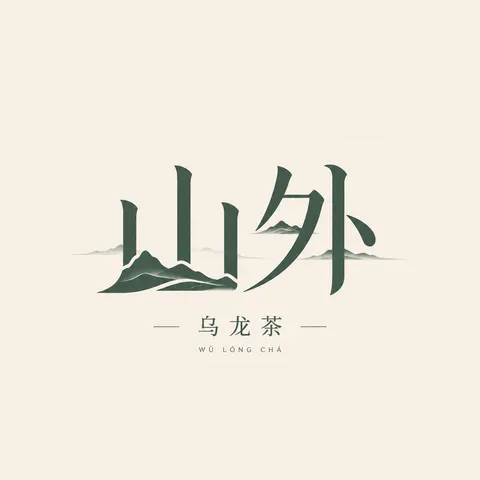
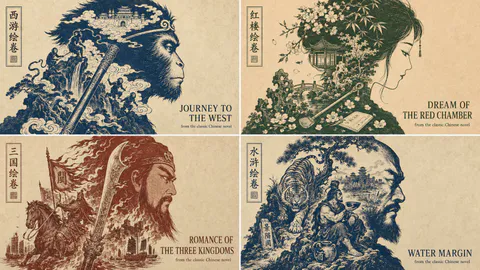
2x2 grid, 16:9, create four completely different Chinese public-domain cultural subjects:

select * from oriental_poster_archives
where cultural_subject = '[$subject]'
and aesthetic = 'minimalist Chinese woodblock poster design'
and print_technique = 'two-color screen print and traditional woodblock print on aged xuan paper'
and optical_illusion = 'gestalt figure-ground reversal'
and visual_language = 'Chinese classical book illustration, refined editorial design, museum-quality composition'
and ink_layers = array[
    (layer_1_base: 'warm aged xuan paper negative space', color: 'ai_infer_light_paper_color([$subject])'),
    (layer_2_foreground: 'flat Chinese landscape, architecture, plants, animals and narrative scenes', color: 'ai_infer_dark_ink_color([$subject])')
]
and masking_logic = (
    select iconic_profile_silhouette
    from Chinese_cultural_character_archive
    where subject = '[$subject]'
    format as 'the edge of the landscape and architecture forms a clear human or mythical-creature profile silhouette'
)
and internal_scene_logic = 'the silhouette contains the most iconic locations, objects, animals and story events associated with the subject'
and typography = 'small vertical Chinese seal-script title panel on the outer edge, elegant English serif title at lower right'
and composition = 'large silhouette occupying 45 to 60 percent of each panel, generous empty paper space, balanced asymmetry'
and forbidden_elements = 'no gradients, no 3D, no photorealism, no floating face, no collage, no modern objects, no neon colors, no random text, no malformed Chinese characters';

[$subject] = Journey to the West, Dream of the Red Chamber, Romance of the Three Kingdoms, Water Margin
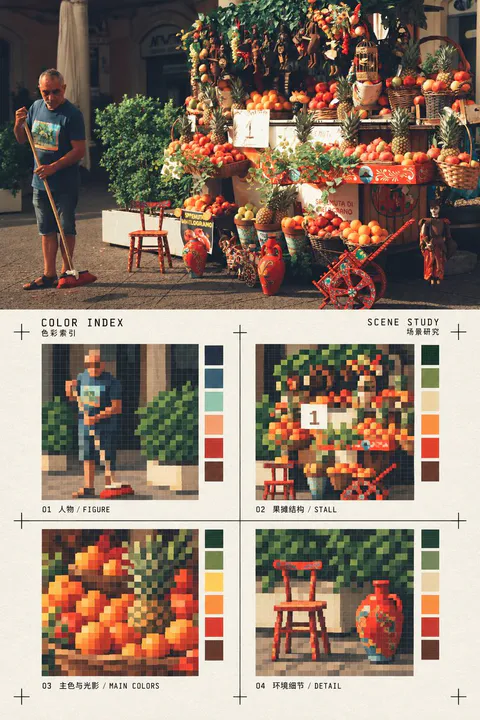
使用一张真实照片作为唯一内容来源,制作一张竖版上下对比编辑海报。上半部完整保留输入照片的真实摄影质感、主体身份、数量、姿态、空间关系、光线和构图,不把照片画成插画;下半部为同一照片的风格化转绘区:在暖白纸面上,把画面提炼成四个等大的方形像素色块索引,分别对应照片中最有辨识度的主体轮廓、建筑或物体结构、主色与光影关系、一个环境细节。每格使用有限色数的硬边像素块和低分辨率网格感,保留可追溯的形体,不做随机马赛克。四格排列为2×2,周围留出充足纸面;用细黑色十字裁切/定位标记框住索引区域,加入极少量小型双语标题与字段,例如“COLOR INDEX / SCENE STUDY”,文字克制、清晰、像印刷校样标注,不喧宾夺主。下半区必须像一张经过设计的色彩索引卡,而不是滤镜、普通像素化或重复照片;不增加无关物件,不改变照片主题。上下区域约各占一半,水平边界清楚;禁止左右并排、禁止多图拼贴、禁止“原图/AI图”角标、禁止水印和品牌标志。所有颜色从输入照片提取并压缩,四格内容随照片主体变化,适用于人物、动物、建筑、街景、自然、室内、食物和物件等任何照片。
 GPT Image 2