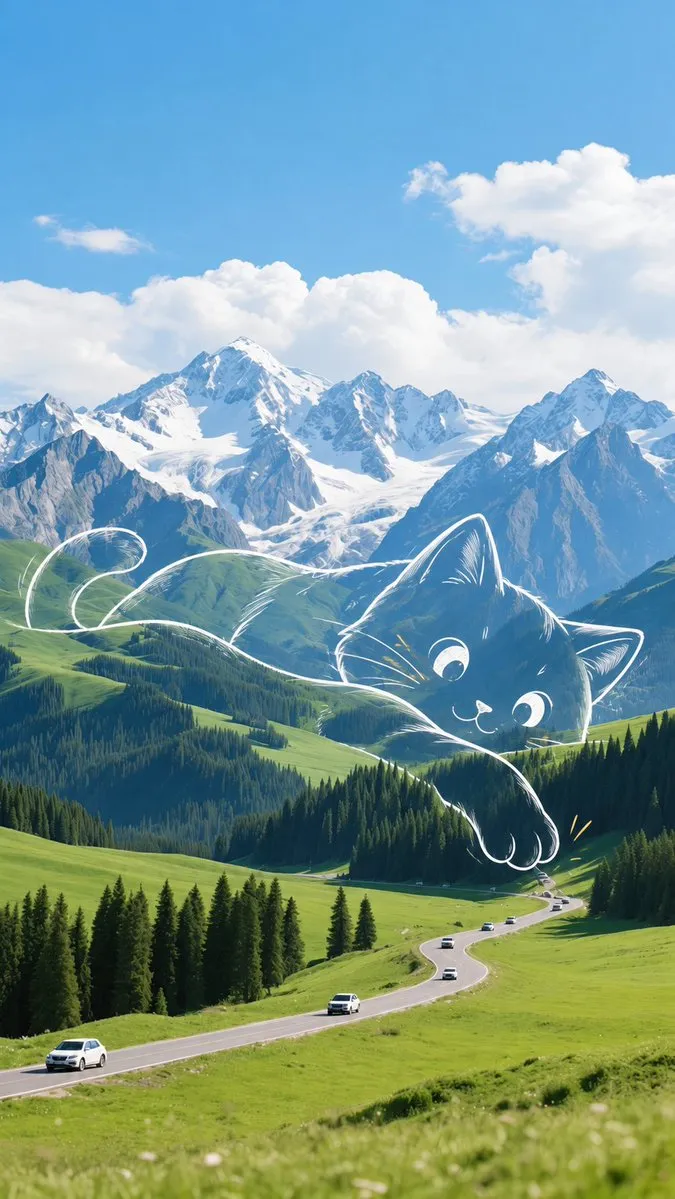
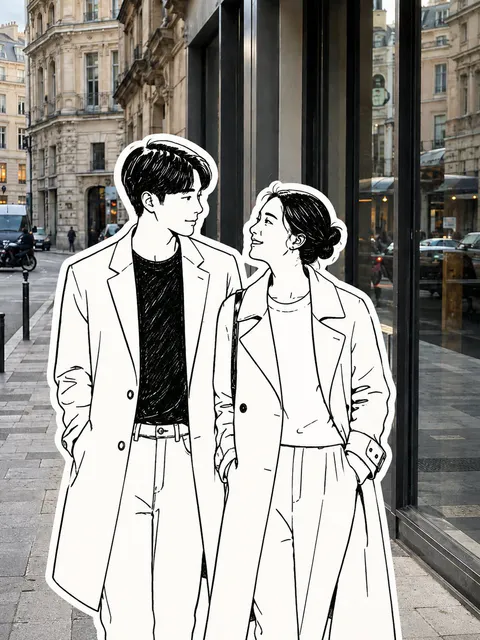
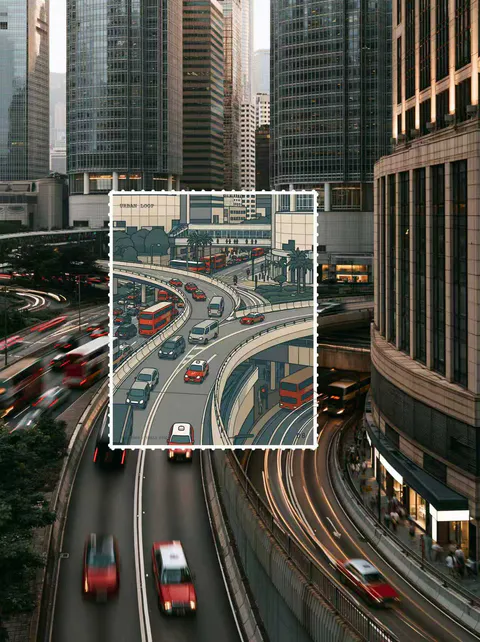
Please transform an uploaded photo into: Real photography × white hand-drawn cat doodle creative illustration. Overall visual style: Photography × Hand-drawn Doodle Illustration / Mixed Media / Visual Metaphor / Surreal Scale Play / Editorial Illustration. Preserve the original photo environment and subject. Add a giant white line-art cat cleverly interacting with the real scenery, drawn like white marker or chalk doodle with minimalist features, natural perspective, and optional subtle mustard yellow accent highlights.
Fotografía real combinada con líneas minimalistas blancas para integrar un gato gigante interactuando con el entorno, creando un arte curativo y surrealista.
Cómo usar este prompt
Copia el prompt original.
Pégalo en 通用 / 未注明.
Genera con la proporción —.
Posted on X by @nima2qisi2. PromptGallery only indexes it. Copyright stays with the author.
FAQ
¿Para qué modelo es este prompt?
El autor lo generó con 通用 / 未注明. La proporción recomendada es the original ratio. Otros modelos parecidos pueden usarlo, con resultados distintos.
¿Cómo se usa?
Copia el prompt original, cambia el tema como en “Gato gigante dibujado sobre fotografía real” y pégalo en 通用 / 未注明.
¿De quién son la imagen y el prompt?
Son de Dmiao豆苗啊 (@nima2qisi2). Post original: https://x.com/nima2qisi2/status/2108362553831387582
【Title】[TITLE]
【Subtitle】[SUBTITLE]
【Landscape】[canyon / river / cloud mountains / glacier / desert / coast]
【Main Palette】[PRIMARY COLORS]
【Scale Anchor】[tiny traveler / canoe / boat / small building]
【Visual Destination】[moon / distant light / horizon / mountain pass]
【Aspect Ratio】9:16

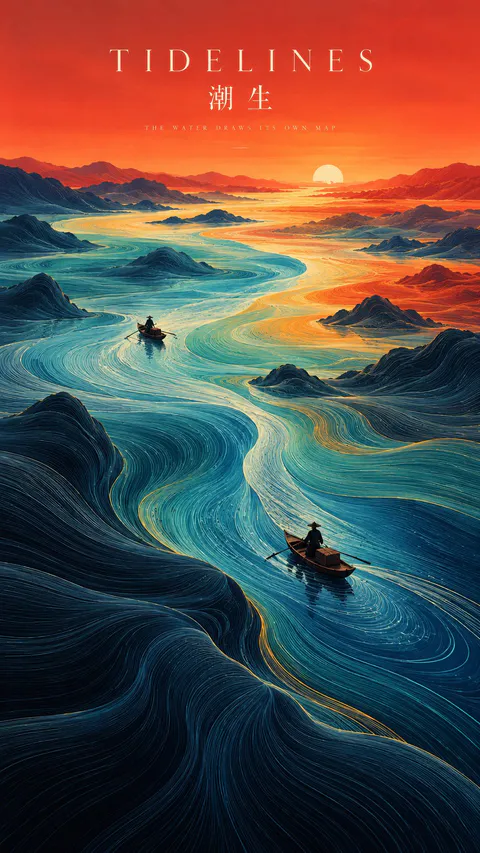
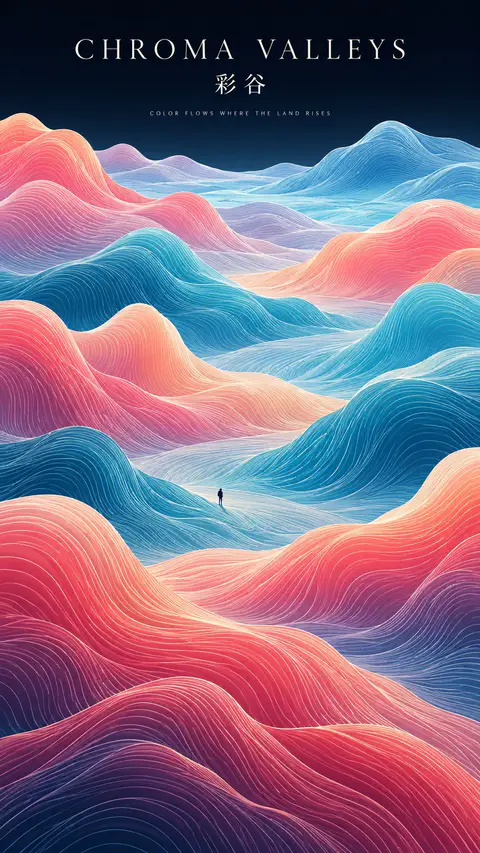
Create a refined vertical art poster that transforms a natural landscape into a flowing topographic world.

Build the terrain from hundreds of long, smooth, continuous contour lines that follow the shape, depth, and movement of the land. The lines should feel like a fusion of topographic maps, silk threads, and abstract Chinese landscape painting — directional, elegant, and highly organized rather than random decorative waves.

Use one strong visual path, such as a river, valley, ridge, cloud road, or negative-space corridor, to guide the eye from foreground to distance.

Keep the natural environment monumental and place only one or two extremely small human figures, boats, or architectural elements as scale anchors.

Use clear spatial hierarchy:
dense flowing lines in the main terrain,
calmer negative space around the visual path,
simpler and softer details in the distance.

Control the palette with 2–4 dominant colors rather than evenly distributed rainbow tones. Use large, clean color fields and let color changes reinforce depth and movement.

Add minimal editorial typography:
[TITLE]
[SUBTITLE]
[SHORT POETIC LINE]

Typography should feel like a contemporary exhibition poster or art-book cover — elegant, widely spaced, restrained, and secondary to the landscape.

The final image should feel poetic, monumental, calm, and highly designed, combining Eastern landscape aesthetics, contour-line abstraction, negative space, and modern editorial composition.
【Landscape】[LANDSCAPE]
【Line Structure】[LAYERED / FLOWING / RADIATING / DIRECTIONAL]
【Palette】[COLORS]
【Scale Anchor】[TINY FIGURE / FLAG / BOAT / TENT]
【Aspect Ratio】9:16

Create a refined vertical art poster that transforms the landscape into an abstract **contour-line world**.

Build the terrain primarily from long, smooth, continuous lines that follow its volume, direction, elevation, and movement.

The lines should become the landscape itself, not simply decorate its surface.

Use one clear structural system and strong line-density variation, with dense lines around major forms and more breathing room in calmer areas.

Use 2–5 related colors and let the colors flow naturally along the contour structure.

Keep the landscape monumental and use only one tiny scale anchor.

Add minimal editorial typography:

[TITLE]
[SUBTITLE]
[SHORT POETIC LINE]

High-end exhibition-poster aesthetic, abstract Eastern landscape feeling, strong thumbnail readability, large graphic forms, controlled negative space, and highly visible contour-line structure.
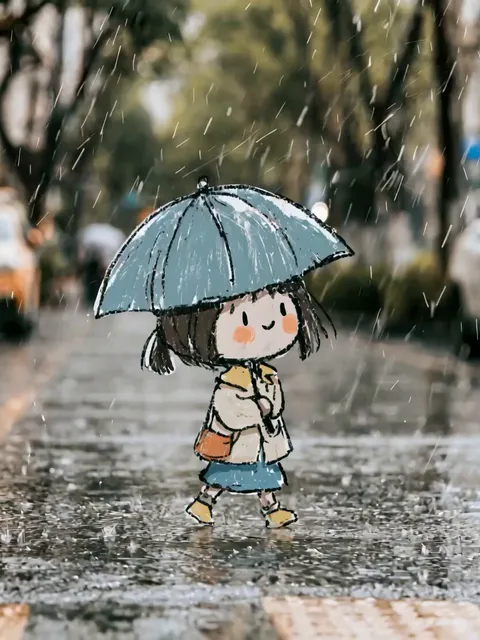
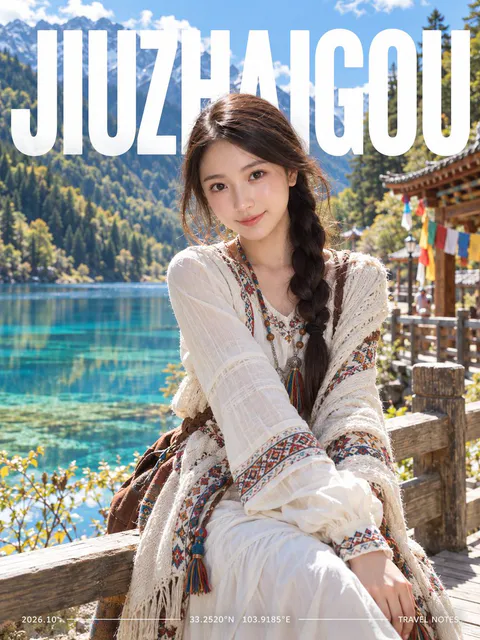
a 2D cartoon-style sitcker girl walking on a realistically photographed Chinese city street with rain, the trees is shaking heavily, the background is realistically photography, real photo city background, constract for cartoon and real photo
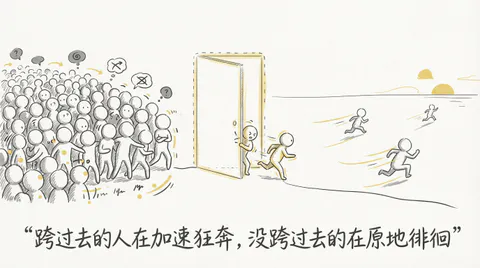
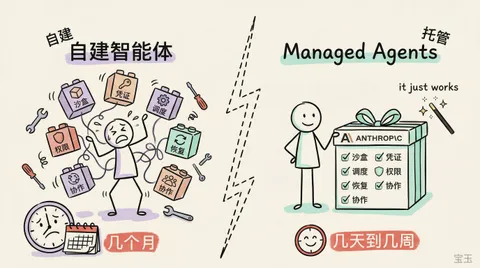
Minimal hand-drawn illustration, off-white paper background, dark gray sketch lines, muted umbrella yellow as the only accent color, lots of negative space, Notion-like doodle aesthetic, faceless round-headed human figure, clean editorial composition, conceptual rather than literal, simple background, no realism, no 3D, no painterly texture, no high saturation, no complex scene, no photographic detail. Add one short Chinese quote in a natural handwritten style near the bottom. The overall mood is restrained, lucid, slightly ironic, and emotionally calm. Keep the whole series visually consistent. Use Chinese wherever possible for any visible language or textual content, unless a proper noun, technical term, or special usage is better kept in its original form.
【POSTER TITLE】{e.g. RIVER OF LIGHT}
【SUBTITLE】{short poetic sentence}
【LANDSCAPE】{mountain valley / gorge / river / basin / cliffs}
【MOOD】{twilight / moonlit / quiet / monumental / mysterious}
【COLOR PALETTE】{deep blue, black, teal, warm ivory, burnt orange}
【SMALL TEXT】{series name / field study / archive / year}

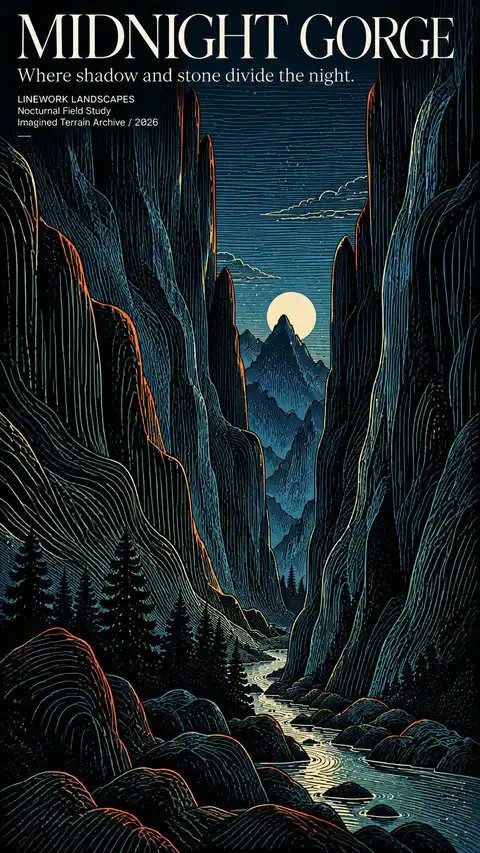
Create a 9:16 vertical English landscape poster built primarily through flowing contour linework and bold color.

Design the landscape first with strong, simple, readable landforms: monumental mountains, cliffs, valleys, rivers, ridges, forests or open terrain. The composition must remain visually powerful even at thumbnail size.

Use long, continuous lines to describe the structure and volume of the landscape. Mountain lines should follow slopes, ridges and geological folds; rivers and paths should create natural visual movement; sky lines should be calmer, longer and more horizontal. The linework must feel directional and intentional rather than random hatching or decorative noise.

Use a bold but controlled palette. Combine deep ink black and dark blue landforms with glacier blue, muted teal and warm ivory linework. Add small areas of burnt orange or copper along selected ridges, terrain edges or vegetation to create strong contrast and visual energy.

Keep the main shapes dark and graphic, then use line density and color shifts to create depth. Avoid excessive micro-detail, distressed texture, messy cross-hatching, neon effects or generic fantasy lighting.

Integrate refined editorial typography directly into the composition. Use an elegant high-contrast serif for the main title, supported by smaller modern text. The typography should feel like an art publication or exhibition poster, not a travel advertisement.

Use only meaningful text related to the poster concept. Do not add random slogans, filler copy, fake coordinates, meaningless labels, logos, Chinese characters or watermarks.

The final result should feel like a complete collectible artwork — part topographic drawing, part printmaking, part contemporary editorial poster design.