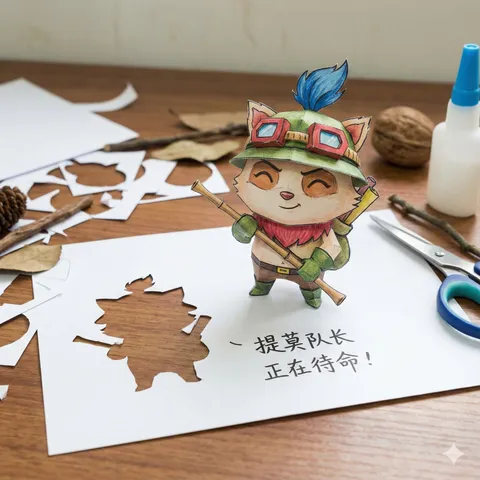
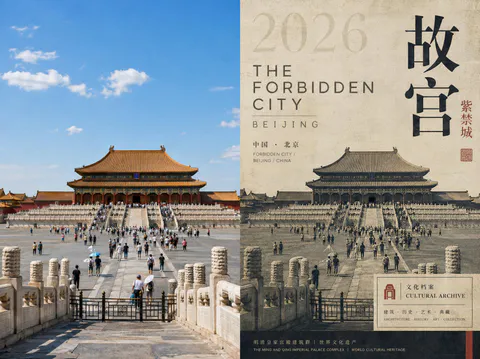
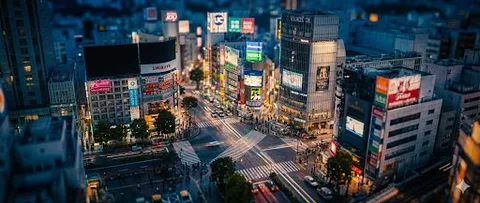
A highly detailed tilt-shift photography of [LOCATION], captured from a high vantage point at [SCENE, e.g., a Japanese commercial street at dusk during sunset], transforming the iconic structure and surrounding landscape into a whimsical miniature toy model scene, with pinpoint sharp focus on the central elements like buildings, pathways, and key landmarks, gradually blurring into soft bokeh towards the edges and foreground/background, with the blurred parts exhibiting the lemon-shaped bokeh aperture etching effect from last century lenses, for an exaggerated shallow depth of field effect; vibrant color palette featuring [COLOR SCHEME, e.g., warm oranges and deep blues], intricate textures on surfaces such as stone, foliage, or water reflections, subtle atmospheric haze or mist adding depth and realism, photorealistic rendering with high dynamic range lighting casting long dramatic shadows, ultra-high resolution 8K, cinematic composition emphasizing symmetry and leading lines, in the style of professional architectural miniature photography.
You are a scientific historian + visual prompt engineer.

INPUT:
{科学发现或发明}

TASK:
Automatically infer and determine, with high confidence:
- The correct scientific discovery name (Chinese + English)
- The primary discoverer(s) full name(s)
- The approximate year or historical period of discovery
- The most iconic origin moment of this discovery
- The historical location where it occurred
- The core scientific idea, expressed in ONE simple Chinese sentence
- Suitable visual scientific symbols (equations, structures, metaphors)

Then OUTPUT a SINGLE, FINAL image-generation prompt in ENGLISH.

CRITICAL RULES:
- The discoverer’s name MUST be explicitly written and clearly visible on the right page of the book
- The discoverer must appear as a realistic 3D human figure in the left-page diorama
- Do NOT include reasoning or explanations
- Do NOT show variables or placeholders in the output
- Output ONLY the final image prompt

FINAL IMAGE PROMPT SPECIFICATION:

Scene:
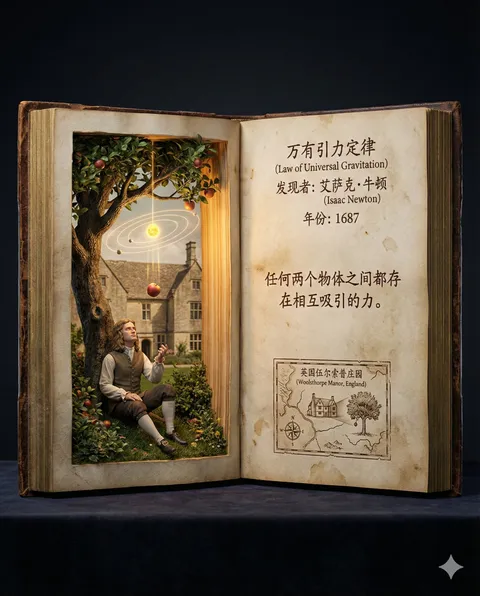
A hyper-realistic 4:5 macro photograph of an ancient scientific codex opened flat on a dark velvet museum plinth. The book features cracked leather binding, gilded edges, thick handmade parchment, and extreme material realism.

Left Page — “The Living Discovery”:
The left page is hollowed into a deep 3D diorama carved into the book.
Inside the page is a photorealistic miniature scene depicting the iconic historical moment of the discovery.
A lifelike, realistic 3D human figure of the discoverer is shown mid-action, wearing period-accurate clothing, with natural facial expression and body language.
The environment precisely matches the historical time and location.
Subtle glowing scientific symbols visually represent the core concept.
A warm amber glow emanates from within the pages.

Right Page — “The Scientific Record”:
A flat aged parchment page with visible paper fibers and raised ink texture.

At the top, clearly write:
- Discovery name (Chinese + English)
- Discoverer name(s) (clearly labeled as “发现者”)
- Discovery year or period

In the center:
Write ONE clear, simple Chinese sentence explaining the scientific discovery, suitable for general audiences.

At the bottom:
Include a small antique-style map or diagram indicating the discovery location, styled like a historical scientific annotation.

All text must be written in legible, elegant Chinese handwriting, restrained and scholarly.

Style & Camera:
Museum specimen photography.
85mm macro lens.
Shallow depth of field.
Cool gallery spotlights combined with warm internal glow.
Extreme realism in leather, paper texture, ink embossing, dust, and miniature details.

Output:
ONE single image.
Aspect ratio 4:5.
Ultra-high resolution.
Photorealistic, cinematic.
No illustration, no cartoon style.
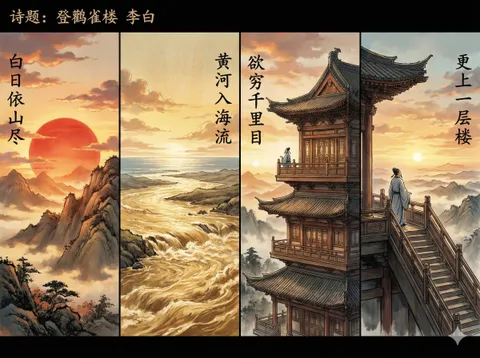
Create a captivating poetic visual composition based on this prompt, seamlessly integrating the four lines of the quatrain into a unified masterpiece. Each panel perfectly illustrates one line of the poem, with the corresponding verse and the poem’s title and author elegantly embedded within its respective scene using Chinese characters. Together, these panels form a harmonious and cohesive panoramic artwork. Rendered with rich detail, cinematic lighting, 8K resolution, and highly refined textures. --ar 4:3

Poem Title: 登鹳雀楼
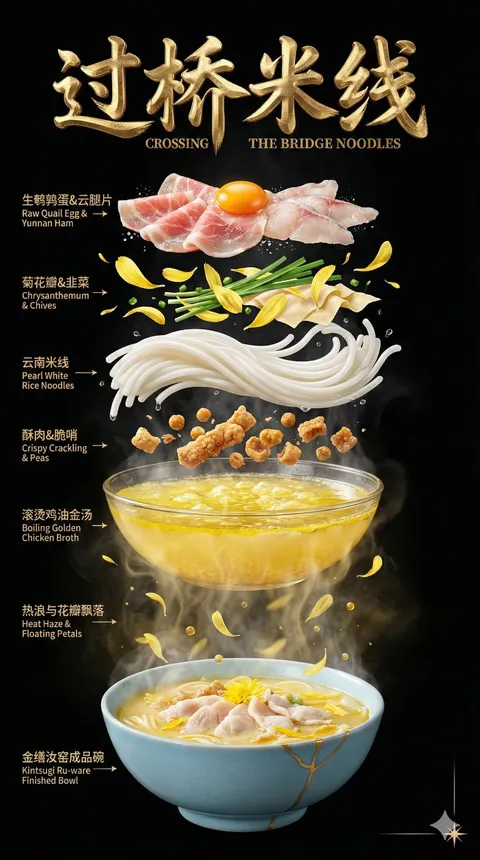
At the very top center of the composition, floating prominently above the ingredient layers, is a luxurious title label. The text reads "过桥米线 CROSSING THE BRIDGE NOODLES" rendered in expressive, handwritten Chinese brush calligraphy (毛笔字) style. The lettering possesses a heavy, three-dimensional sculpted gold metal texture (金属质感) with a brushed finish, warm golden sheen, and realistic metallic reflections catching the dramatic studio lighting. It looks like forged gold brushstrokes floating in space.
Premium Chinese Yunnan cuisine food poster featuring deconstructed layers of Crossing the Bridge Noodles floating in vertical stack on pure black background (#000000). Seven distinct layers from top to bottom (below the main gold title) with extra spacing before the final dish:
Top layer: A raw quail egg yolk (glowing orange-gold) surrounded by paper-thin, translucent slices of raw Yunnan Ham and fish fillets. The meat shows delicate marbling and light pink translucency, emphasizing freshness.
Second layer: Elegant yellow Chrysanthemum petals (菊花瓣) scattered mixed with bright green garlic chives and sheets of pale tofu skin. The petals add a luxurious floral aesthetic.
Third layer: Thick, round, pearly-white Rice Noodles (Mixian), arranged in a smooth, flowing wave pattern. They look wet, slippery, and distinctly different from yellow wheat noodles.
Fourth layer: Crispy pork crackling pieces and fried peas suspended in air, adding golden textural crunch accents.
Fifth layer: A large transparent glass bowl filled with boiling hot Golden Chicken Broth (金汤). A thick layer of yellow chicken oil seals the surface. Micro-simmering bubbles burst languidly under the oil layer, indicating extreme heat.
Sixth layer (Atmosphere Layer): EMPTY SPACE - a larger gap filled with intense thermal atmosphere. Visible heat haze distortion waves (热浪扭曲) rise from the hot broth below, blurring the background air slightly. Swirling dense steam mixes with slowly falling chrysanthemum petals and microscopic droplets of golden chicken oil caught in thermal currents, creating a dreamlike, misty transition.
Bottom/Final layer (The Art Vessel): A complete finished Crossing the Bridge Noodles dish presented in a museum-quality Ru-ware style ceramic bowl (汝窑风格) with a matte sky-blue glaze and subtle fine ice-crackle patterns throughout. A distinct line of Kintsugi gold repair (金缮修复) runs down one side of the rim, adding artistic history. The bowl contains the milky golden soup with all ingredients submerged. The raw meat is now cooked white, and petals float on the rich oil surface. Intense steam rises from the artisan bowl. This finished bowl is at the same scale and viewing angle as the deconstructed ingredients above.
Each layer separated with gaps revealing textures and details. Layers 1-5 have normal spacing. Layer 6 is an intentional empty transition space with double the normal gap distance, emphasizing heat. Layer 7 (finished dish) sits at the bottom with clear visual separation. Chinese and English bilingual labels with elegant arrows pointing to each component: "生鹌鹑蛋&云腿片 Raw Quail Egg & Yunnan Ham", "菊花瓣&韭菜 Chrysanthemum & Chives", "云南米线 Pearl White Rice Noodles", "酥肉&脆哨 Crispy Crackling & Peas", "滚烫鸡油金汤 Boiling Golden Chicken Broth", "热浪与花瓣飘落 Heat Haze & Floating Petals", "金缮汝窑成品碗 Kintsugi Ru-ware Finished Bowl".
NO white pedestal, NO platform base. All layers float freely in space against pure black background. Dramatic studio lighting from 45-degree angle, rim lighting highlighting the translucency of the raw meat, the golden glow of the soup, and the gold details on the final bowl. All layers share identical lighting, perspective angle, and photorealistic quality. Intense steam effects, oil droplets, and flower petals floating around layers. Star sparkle effect in bottom right corner. Dark moody aesthetic, luxurious commercial food photography style, ultra-realistic, highly detailed, professional restaurant advertising quality, 9:16 vertical format.
 通用 / 未注明3